
The Lok Sabha results on June 4, 2024 for the 80 seats in Uttar Pradesh was nothing less than a twisted climax that almost no one saw coming. Almost everyone was surprised – some were ecstatic and some were depressed but everyone was affected. Out of eighty Lok Sabha seats BJP won only 33 seats i.e. 29 seats less than it won in 2019. On the other hand, SP (Samajwadi Party) that looked like fighting an existential crisis, won 37 seats i.e. 32 more than their last tally in 2019.
Also read: Atrangi Bhaiya Ji and The downfall of Samajwadi Party and the end of Akhilesh Yadav’s political career!
As soon as the results were out, a variety of conspiracy theories, narratives and propagandas started to appear. I am quite certain, you must have come across at least one of them if not all of them.
- BJP lost its seats in UP because of the split between Modi and Yogi. Yogi’s recommended list of candidates were rejected by the center and that’s the state leadership did not actively participate in the contest and were only name sake.
- The second narrative is quite similar to the first one, only difference being that instead of the rift between Yogi and Modi, the rift is between BJP and RSS.
- The third narrative is quite interesting: BJP lost the UP elections because of low voter turnout. The “400 Paar” slogan got BJP voters and workers complacent and so ending up underperforming.
- Another narrative is BJP losing Ayodhya (Faizabad) constituency because of the administration of the Ram Mandir construction. According to some the state did not provide the compensation for the people who were displaced because of the construction that happened because of Ram Mandir like the wider roads, bigger railway station, a brand new airport etc.
- Some analysts promote a narrative that Samajwadi Party has become secular and have gone beyond its caste vote bank of Yadavs. According to them Akhilesh Yadav now knows how the balance the caste equation.
- Another interesting narrative is that BJP lost the seats because they imported a lot of candidates from different parties leading to their own party workers disheartened and so they didn’t do what they were supposed to do.
- And the easiest narrative being BJP lost the seats because of their arrogance and their belief of invincibility or the Hindus of UP betrayed the party.
Does any of the above mentioned narratives reach you? Its highly unlikely that they didn’t reach you. I am quite certain you must be wondering if there are any teeth to any of these.
Some of the narratives are quite hilarious and can be discarded in minutes. For example the BJP-RSS rift. Why and how is it that the rift is only in the state of UP? What about states like Madhya Pradesh, Odisha, Arunachal Pradesh, Uttarakhand, Himachal Pradesh, Gujarat, Bihar, Assam, so on and so forth? So RSS and BJP were friends at every other state where BJP won but the one state where it faltered it was BJP and RSS rift. Does that make sense? The harsh reality is if there was or will be any rift in BJP and RSS, BJP will lose all the states. BJP and RSS can exist only when they are together, and that’s why the opposition and the left ecosystem always targets RSS as much as it can when in power. Don’t forget the time between 2004 to 2014; RSS was even accused to be a conspirator of 2008 Mumbai Terror attacks.
BJP importing candidates – rift with RSS – or BJP getting arrogant or complacent are not unique to Uttar Pradesh, they could have been the reason if the party’s performance across all the states was like this. The left dominant ecosystem wants to kill two birds by a single stone: they want to hide the real reason what exactly happened in UP and second provoke BJP supports and hope the people start distrusting each other; divide and rule! British taught us a wonderful scheme!
Another narrative that low voter turnout along with “400 Paar” causing voters and the party workers to be complacent was the reason of BJP’s loss in the state is nothing more than a half baked or rather fake narrative. As a matter of fact the constituencies’ where the voter turnout was the lowest BJP won most of them and that too with a huge margin. Have a look at the table below, I have put only top twenty seats (top in terms of the biggest decrease in voter turnout, the column %decrease indicate the decrease from 2019 numbers) . 12 out of these twenty seats were won by BJP; adding two of RLD takes the NDA tally to 14. SP won only five out of twenty and INC only one. Meaning, BJP won 70% of such seats.

So, how are the clever political analysts claiming that the low voter turnout cost BJP seats? As a fact the number says the other way around. The seats where the voter turnout was low, BJP won. The slogan “400 Paar” actually demoralized many anti- voters to not come and vote. At least the numbers say so.
The same flawed narrative of people of Ayodhya not voting for BJP because of compensation and rehabilitation; it is once again failed attempt to mislead people into believing that it was government’s mismanagement or corruption that caused them the setback. Let us for the sake of the argument assume that there was mismanagement and corruption regarding the reconstruction then:
- Why did BJP lose other thirty odd seats in the state? Was the reconstruction due to temple occurring in all the constituency?
- More importantly, it’s not just Ayodhya that falls under Faizabad Lok Sabha constituency. There are five different assembly segments, namely: Dariyabad, Rudauli, Milkipur(this is a SC reserved segment, Awadesh Prasad who won Loksabha seat now had won from this seat in 2022 Assembly elections), Bikapur and Ayodhya (where Ram Temple is). If compensation and construction was a problem why did other segments not vote for BJP or why did they vote for SP?
The simple answer is that BJP was losing its hold even before the Temple was built. Below is the table showing change in the voting patterns between 2017 Assembly elections and 2022 Assembly elections specifically for Ayodhya Assembly. BJP won this seat by a margin of 50,000 in 2017, however won by less than 10,000 in 2022.
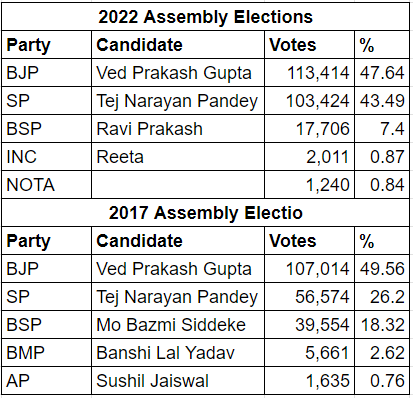
The reason is not construction or any other government performance related. It is as simple as Muslim-Dalit vote consolidation. Look at the vote count and the vote share of BSP in the table above. BSP’s vote share reduced by more than 10% from 18.32 to 7.4 percent and half of its voters switched sides. Where did they go?
Also read: Akhilesh Yadav’s SP will struggle to win 50 seats in the upcoming UP Elections 2022
This pattern is very similar for the Lok Sabha elections of 2019 to 2024. BSP lost more than 10% of its vote share from 19.43% in 2019 to 9.39% in 2024. The party failed to win even a single seat in 2024 where it had won 10 in the last Lok Sabha elections. Seven out of those ten seats went to the INDI alliance (six to SP and one to INC). Have a look at the table below:
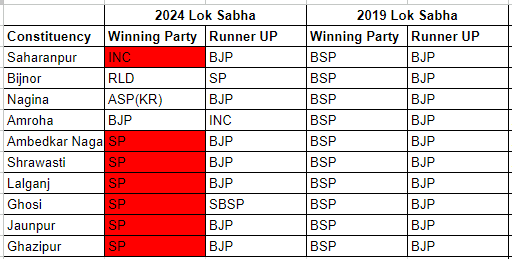
Moreover there were 27 other seats where BSP was runner up in 2019 elections and BJP won those seats, 13 of those seats went to SP (including one to INC) this time. Have a look at the list:

As ugly as it may look, consolidation of Muslim and Dalit votes is the real reason. Development, corruption or anything that make sense to us has absolutely nothing with this election result, its all a façade. You need to scratch the surface just a little bit and the truth will reveal itself. These two communities weren’t voting for BJP in the past and didn’t vote this time. The only difference is their votes were distributed amongst different parties like SP, BSP and Asaduddin Owaisi’s AIMIM, INC but this time the votes consolidated and SP won. The people who were voting for BJP still voted for BJP.
Also read: Remembering some of the iconic work by Akhilesh Yadav during his days
The next assembly election in UP will be quite interesting. Chirag Paswan’s Lok Jan Shakti Party will definitely be worth following!!
Thanks for reading! I hope you liked the analysis, if you did please do like it and please share it with your friends and family. We need to correct the narratives!!
Also read:











 Infinite Sea of Opportunities
Leave a comment