
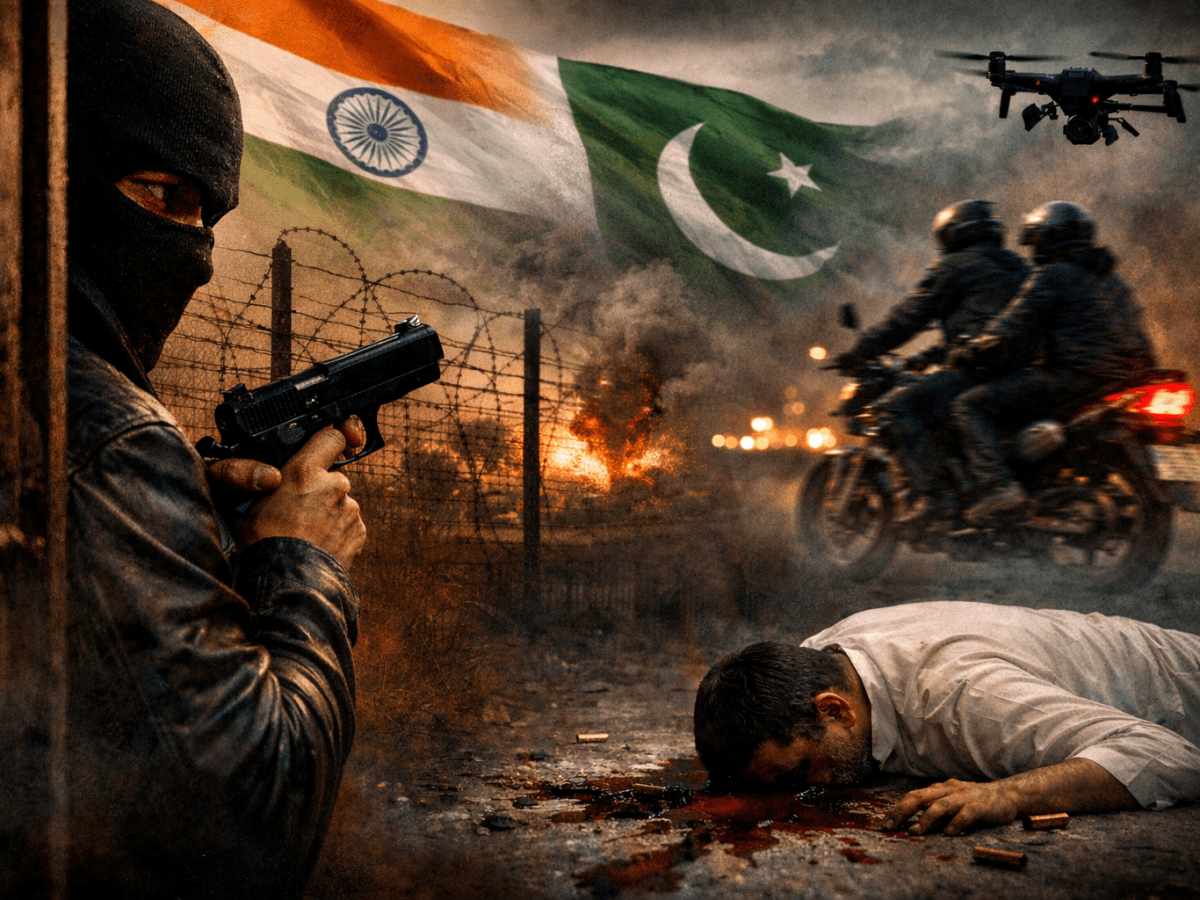
The India-Pakistan clash of April-May 2025 was a fiery saga of terror, hubris, and crushing defeat. It began with a brutal terror attack in Pahalgam, Indian-administered Kashmir, on April 22, killing 26 innocents. India pointed the finger at Pakistan-backed groups like Lashkar-e-Taiba (LeT), and what followed was a relentless showdown that exposed Pakistan’s military as a paper tiger and its propaganda as a sham. By May 10, a U.S.-mediated ceasefire stopped the escalation, but not before India’s iron fist forced Pakistan to its knees. Here’s the story of how it unfolded—and why Pakistan had no choice but to surrender to peace.
After India accused them of orchestrating the Pahalgam attack, tensions erupted along the Line of Control (LoC). On the night of May 6-7, India unleashed Operation Sindoor, a thunderous strike that lit up the Pakistani sky. Rafale fighters, armed with SCALP cruise missiles—stealthy, long-range weapons with a 560 km reach, designed to penetrate deep defenses—soared over Bahawalpur, striking a JeM terror camp and killing close aides of Masood Azhar. Then came the BrahMos supersonic missiles, the world’s fastest cruise missile at Mach 3, unstoppable with its 600 km range, slamming into Pakistan’s air bases at Murid and Rafiqui, near Lahore and Islamabad. The explosions sent shockwaves through densely populated areas—Pakistan’s air defenses, the outdated HQ-9 system, a Chinese copy of Russia’s S-300 with a 200 km range but slower response, crumbled like paper, unable to stop the BrahMos’ hypersonic fury. India’s Harop drones, Israeli-made loitering munitions that self-destruct on impact, known as “kamikaze drones,” followed, taking out Pakistani radar sites, leaving their military blind.
The Battle Unfolds: A Tale of Fire and Failure
Pakistan then launched Operation Bunyan al-Marsus, hoping to strike fear into India’s heart. They fired a barrage of Shaheen-II ballistic missiles from Sialkot—long-range beasts capable of carrying nuclear warheads, designed to intimidate with their 2,500 km reach—aiming for India’s military base in Udhampur. The missiles screamed across the sky, but India was ready. The S-400 Triumf system, a Russian-supplied juggernaut with a 400 km range and unmatched accuracy, roared to life, intercepting the Shaheen-II mid-flight like a hawk snatching prey. Debris rained harmlessly over Jammu, a minor scare but no damage.
Pakistan doubled down, sending Fatah-1 guided rockets—a multi-launch system with precision targeting, built to overwhelm defenses—and Babur cruise missiles—stealthy, terrain-hugging weapons with a 700 km range, meant to slip past radar—toward Pathankot to cripple India’s airbase. But India’s Akash SAMs, a homegrown system with a 25 km range, perfect for rapid intercepts, swatted the Fatah-1 rockets out of the sky, while the Barak-8 system, a joint India-Israel marvel with a 100 km range, took down the low-flying Babur missiles with surgical precision. A single Fatah-1 fragment caused a minor injury in Jalandhar, but India’s bases stood untouched. Pakistan’s drones—Burraq, a combat UAV with laser-guided missiles, designed for pinpoint strikes, and Shahpar-II, an advanced surveillance drone with a 20-hour endurance—tried to sneak into Punjab, but India’s Rafale jets, French-made fighters with Meteor missiles and a 3,700 km range, swooped in, tearing them apart before they could strike. Pakistan’s attack was a dud, a fireworks show with no bang.
India wasn’t about to let this slide. By May 10, India had destroyed six Pakistani air bases, drone launchpads, and terror hubs, killing over 100 militants, as per Defence Minister Rajnath Singh.
Pakistan tried one last push, launching Ra’ad cruise missiles—air-launched, stealth missiles with a 550 km range, designed to evade radar—from their J-10C jets, China’s answer to Western fighters with advanced avionics. But India’s Su-30 MKI fighters, heavily armed beasts with a 3,000 km range, perfect for air superiority, intercepted them mid-air, turning Pakistan’s retaliation into a graveyard of twisted metal. The Akashteer network, India’s cutting-edge air defense system that links radar and SAMs in real-time, coordinated every move, ensuring no threat got through. Pakistan’s military was on its heels, their bases in ruins, their drones grounded, their missiles useless. The message was clear: India’s might was unstoppable.
Why Pakistan Waved the White Flag
1. India’s Iron Defence: A Wall Pakistan Couldn’t Break
Pakistan’s entire strategy—relying on missiles and drones—fell apart against India’s defenses. The S-400, Akash, and Barak-8 systems acted like an impenetrable shield, while the Akashteer network turned Pakistan’s salvos into a joke. Pakistan’s HQ-9 couldn’t match India’s firepower, leaving their bases exposed to BrahMos strikes. With no way to inflict meaningful damage, Pakistan’s military was humiliated, their Operation Bunyan al-Marsus a complete failure.
But India’s defensive edge went beyond the battlefield. Back in 2019, I predicted on Infinite Sea of Opportunities that India’s ASAT test would change the game—I was right. On March 27, 2019, Prime Minister Modi, addressed the nation and informed everyone about India’s Mission Shakti that destroyed a microsatellite in low Earth orbit (300 km altitude) with a Prithvi Defence Vehicle Mark-II, a modified BMD interceptor with a 2,000 km range, capable of neutralizing space threats. This wasn’t just a tech demo—it was a warning. In 2025, Pakistan, reliant on Chinese satellites for military communications, knew escalation risked losing its orbital eyes. The ASAT tech supercharged India’s BMD systems, integrating space and missile defense to crush Pakistan’s missile attacks. There are significant technology overlaps between ASAT and BMD, however BMD is strictly military but ASAT has non military uses as well and that’s why country’s talk about ASAT hinting at the defence capability. With no way to challenge India’s space dominance, Pakistan’s leadership saw the writing on the wall: keep fighting, and they’d lose everything.
Must read: ASAT, ABM and the shifting Nuclear Paradigm
Defence isn’t just a shield—it’s a game-changer. History proves it: the Soviet Union collapsed in 1991 partly due to paranoia over U.S. defensive capabilities. As I noted in my 2019 ASAT post, the U.S.’s Strategic Defense Initiative (SDI) in the 1980s convinced the Soviets that America could block their nuclear strikes, while the USSR couldn’t stop a U.S. counterattack. This fear drained their resources, fueling internal collapse. In 2025, Pakistan faced a similar nightmare—India’s iron defense meant Pakistan could attack but never win, while India’s offensive strikes hit hard and deep. They had no choice but to call for peace before India struck even deeper.
May 7- May 10 might not be considered a war on paper, but Pakistan literally threw whatever it had in its arsenal, it can’t do any better. Nothing reached India because of its BMD system. Only six countries US, Russia, China, India, Israel, and France have their indigenous BMD systems. Pakistan does not have a BMD in place, that’s why Indian missile attacks were successful. Pakistan can stock as many warheads as it feels like squeezing all the money it can, but none of the missiles will reach India.
2. A Ceasefire to Save Face Amid Lies, Chaos, and Global Pressure
With their military crushed, Pakistan turned to social media fake narratives to save face. On May 10, Prime Minister Shehbaz Sharif, in a dramatic 20-minute speech laced with nationalist fervor, declared the ceasefire a “historic victory” for Pakistan, falsely claiming that their military’s “relentless strikes” brought India to its knees and that India begged for the ceasefire. Pakistan news channels amplified this delusion, with outlets like Geo News, Samaa TV, ARY News, spinning tales of Pakistan’s “military prowess” forcing India to back down. But the reality was stark—India’s Ministry of External Affairs confirmed the ceasefire was a mutual agreement, with Pakistan’s DGMO initiating the call, a fact echoed by India’s firm stance that its strikes were precision counter-terror operations, not acts of desperation.
These lies were a desperate bid to pacify Pakistan’s populace and stave off a looming civil war. Baloch liberation army is at its boldest. Public unrest had been brewing since Imran Khan’s arrest in 2023, and the military’s failure only fueled the fire. To calm the rising tensions, Imran Khan was immediately released on parole on May 11, a last-ditch effort to prevent a full-blown revolt. Meanwhile, the U.S. twisted the knife, tying a $1 billion IMF loan to the ceasefire—a lifeline Pakistan couldn’t refuse amidst its FATF grey-listing for terror financing. Global pressure from the U.N., China, and the UAE sealed the deal, isolating Pakistan further. They waved the white flag on May 10, not out of goodwill, but because India’s iron fist, their own internal chaos, and the world’s scorn left them no escape. In its 78 years of history, Pakistan has never been weaker or more helpless than it is today, a nation teetering on the edge, clinging to lies to survive.
The Bigger Picture
Pakistan’s ceasefire is just the latest chapter in its terror-sponsoring saga. My blog, “Pakistan’s Terror Web: DG ISPR’s Lies Unraveled by UN Truths,” exposes how UN-listed groups like LeT and JeM, backed by Pakistan, fuel these conflicts. From Mumbai 1993 to Pahalgam 2025, their bloody trail is undeniable. Check it out to see the full scope of Pakistan’s deception—and why India’s fight for justice must continue. Pakistan should take the Indian Governments statement “an act of terror will now be seen as an act of war” very seriously. Gone are the nuclear bluff days.
Thanks for reading. If you find merit in the article, please do share it as much as possible. Help me spread the awareness and cut through the fake narratives!
Also read:











 Infinite Sea of Opportunities
Leave a comment