
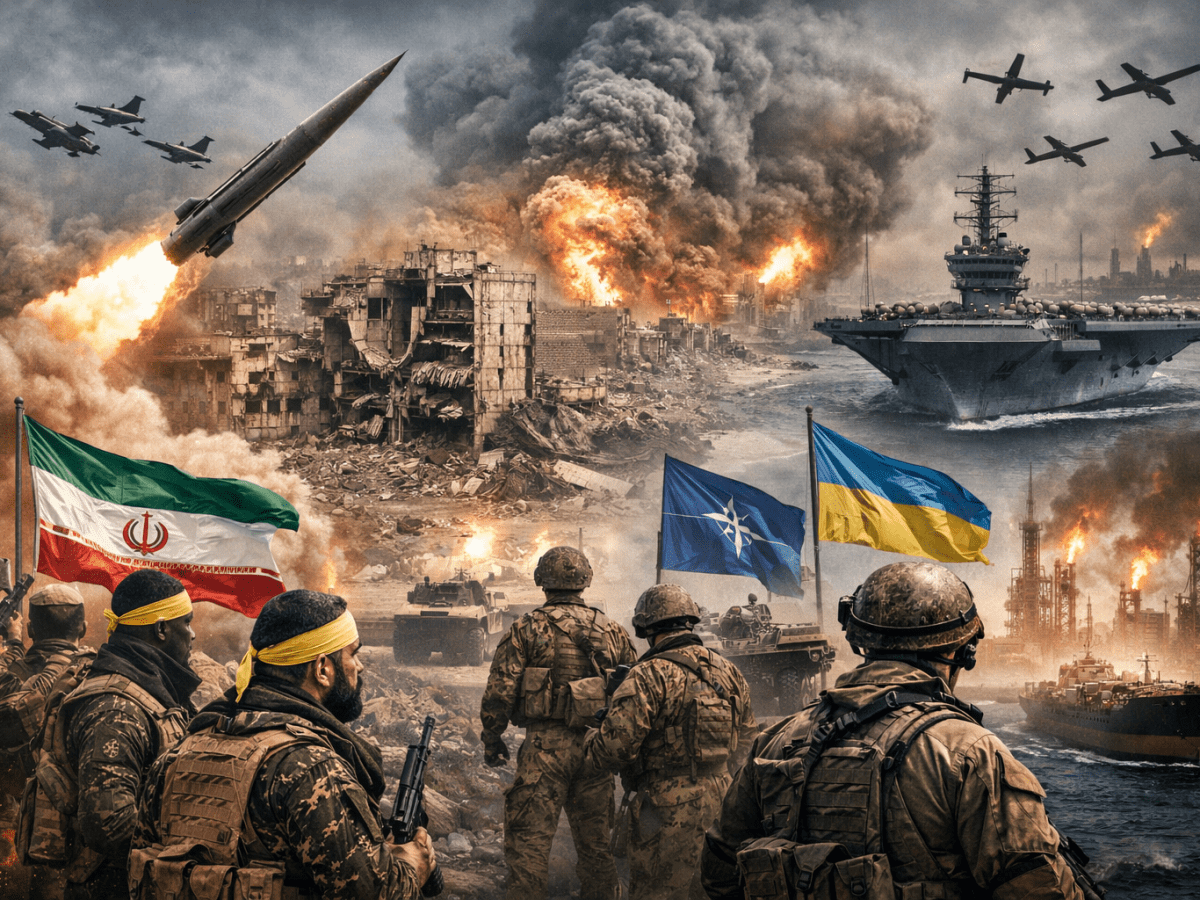
In the high-stakes theater of modern geopolitics, where great powers clash and alliances are as fluid as the markets, India has often been pressured to step out of its seat and onto the stage. Whether it is the ongoing conflict in the Middle East or the performative trade tensions with the United States, the demand from certain quarters—particularly those within the Indian National Congress and their chorus of vocal supporters—is consistent: India must do something. India must take a stand. They clamor that because the US engaged in hostilities with Iran and eliminated its supreme leader, or because the IRIS Dena was sunk in the Indian Ocean, or because the US issued a “temporary waiver” for oil imports, the Indian government should react or retaliate. They frame the government’s calculated silence and strategic calibration as a failure. The underlying, desperate insinuation they push is always the same: Are we slaves to the US?
But let’s pause and apply a simple, rational lens to these demands. Does India have a moral or strategic obligation to jump into the middle of a war between the United States, Israel, and Iran? The short answer is no. And the longer, harder-hitting answer is that doing so would be a catastrophic abandonment of the very principles that keep India’s economy and security resilient.
The Sinking of IRIS Dena: The “Workshop” Fallacy
Let’s use a simple analogy to strip away the diplomatic jargon favored by those who push for intervention. Suppose you invite a group of diverse participants to a workshop in your home. You treat them with hospitality, facilitate their work, and ensure their comfort. When the workshop concludes, the participants head home. On the way, one of them is attacked by his (not yours) old enemy.
Would you feel a moral obligation to jump into the middle of a conflict that has been brewing for years, knowing it could bring the fight to your doorstep and set your own house on fire? You wouldn’t. You would ensure your family’s safety and lock your doors.
Yet, this is exactly the dynamic critics are trying to impose on India regarding the IRIS Dena incident. India hosted the vessel for a routine naval exercise. When it departed, it re-entered international waters—a theater of war where two parties were already locked in a lethal, bloody struggle. India is being asked to bear the burden of a guest’s safety after that guest has left the host’s jurisdiction.
Expecting India to intervene is not “logic”; it is an exercise in geopolitical gaslighting. It ignores the fundamental principle that international waters are not an Indian theater of war. The fact that the ocean is named the “Indian Ocean” does not make the entire body of water Indian territory. That mindset belongs to the expansionist playbook of countries like China, who believe that a name gives them sovereignty over entire seas. To argue otherwise is to invite an unnecessary, destructive entanglement that serves no Indian interest.
The “Pre-emptive” Narrative and the Ego War
We must call this conflict what it is: an ego-driven war of pre-emption. We are told that hitting a ship is a “pre-emptive strike” because, theoretically, it could have been used in the war at some point. By that standard, every ship, every factory, and every resource on the planet is a potential target. The US has not only bombed the military establishment but civilian structures like schools.
When the US justifies such actions, it is following the logic of unipolar hegemony. India has correctly chosen to stay out of the “ego wars” of major powers. The strength of a rising nation is not found in how many sides it takes, but in its ability to refuse to be dragged into conflicts that serve someone else’s narrative.
The Russian Oil “Permission”: A 30-Day Waiver
Nowhere is the disconnect between the Congress’s rhetoric and reality more stark than in the discourse surrounding India’s trade with Russia. Critics today speak as if India’s trade with Russia is controlled by the US. The data tells a vastly different story.
India’s Russian Oil Imports (Share of Total Annual Imports)
The Congress party, which now attempts to mock India’s foreign policy, presided over a decade where India procured less than 1% of its oil from Russia. Can Congress explain why they left India’s energy security so narrow and dependent on a single volatile region? What happened to the energy needs and security of the nation during their tenure?
The irony is deafening: it is the current BJP government that diversified its oil imports and included Russia in its list. Oil imports from Russia increased to 20% in 2022 and, amid the Russia-Ukraine war, increased to 35%. It appears the Congress and its vocal supporters operate under the delusion that India had been importing 40% of its oil from Russia forever, and that it is only now—during recent trade negotiations with the US—that India has reduced it to 20%.
Even after moving from 40% to 20% as part of a trade deal, India still imports twenty times more oil from Russia than it did during the Congress’s entire tenure.
Now that India is navigating a complex trade framework, critics demand we “react” to the language of tweets and temporary waivers. India’s ability to continue trade with Russia proves we have mastered the art of Strategic Autonomy. We are not “obeying” anyone; we are negotiating for the best deal for 1.4 billion people. The biggest irony is that even with tariff negotiations bringing imports down temporarily, the reality of the war has forced a return to higher procurement levels. India and Russia are now discussing long-term contracts precisely because India refuses to be a secondary player in global energy.
Conclusion: Why “Interference” is a Trap
Those calling for India to take a definitive side—to support Khamenei or to support the US/Israel—are asking us to trade our agency for the approval of a foreign power. They are living in the past, dreaming of an era where India was a pawn to be moved around a colonial chessboard. They fail to understand that the India of 2026 is a pole, not a satellite. Even more ironic is that the Muslim nations directly involved in these regional tensions are not aligning with Iran to fight Israel. If those who share the same regional and religious stakes are prioritizing their own national interests over ideological posturing, why should India be expected to do otherwise?
India’s foreign policy is not a collection of favors to be traded; it is a calculated roadmap for national survival and growth. When the world is on fire, the wisest policy is to focus on your own resilience. It is a tragedy that certain political outfits—having failed to secure the mandate of the people—are now working overtime to manufacture artificial pressure. They are not merely criticizing policy; they are actively rooting for a wrong move, hoping that an impulsive, disastrous decision might finally push the nation into the very crisis they so cynically predict.
Let others fight their ego wars. Let them draft their sanctions and tweet their threats. India’s true moral obligation is to its own citizens, to its economic stability, and to the preservation of a peaceful, multi-polar order. Let this be clear: India is no longer a spectator to be swayed, nor a pawn to be sacrificed. Staying out of someone else’s war isn’t cowardice—it is the ultimate display of a sovereign nation that has finally found, and is not afraid to use, its own voice.
Thanks for reading! Please share the post with friends and family and help them understand the dirty politics behind Congress’ move.
Also read:
- Hype vs. Reality: Will Trump’s 100% Tariffs Stop De-dollarization in 2026?
- Hype vs. Reality: Trump’s 50% Tariffs and the Indian Textile Industry
- Beyond the Bombing: What Happens After ‘Victory’ is Declared in Iran?
- The Drone Race: A New Era of Innovation in India Amid Conflict
- Operation Sindoor: India’s Fight for Survival, Not Revenge




 Infinite Sea of Opportunities
Leave a comment