
The official narrative from Washington and the big media houses have spent the last week painting a picture of surgical precision and total air dominance. According to that version of events, Operation Epic Fury is dismantling Iranian military infrastructure with surgical precision. American air power dominates the skies. Strategic targets are being destroyed. The Iranian regime, we are told, is under immense pressure.
But war has a habit of exposing realities that press briefings cannot hide.
A week into the conflict, satellite imagery, maritime tracking data, and the growing anxiety of thousands of American civilians stranded across the Gulf suggest a far more complicated—and potentially dangerous—picture.
If the objective was “regime change” and the “destruction of missile launchers,” the Trump administration is currently facing a strategic catastrophe. Not only is the regime still in power, but it has successfully executed a plan that few in the West thought possible: blinding the American military umbrella.
1. The Death of the “Early Warning” System
The most embarrassing reality the U.S. is trying to mask is the systematic destruction of its “eyes” in the region. To intercept a missile, you first have to see it. Radar networks—particularly early-warning radars—are the backbone of that system. They detect launches, track trajectories, and provide the targeting data needed for interceptor missiles.
Iran’s Operation True Promise 4 has targeted the very sensors that make U.S. defense possible. Several radar installations across the Gulf have reportedly been struck.
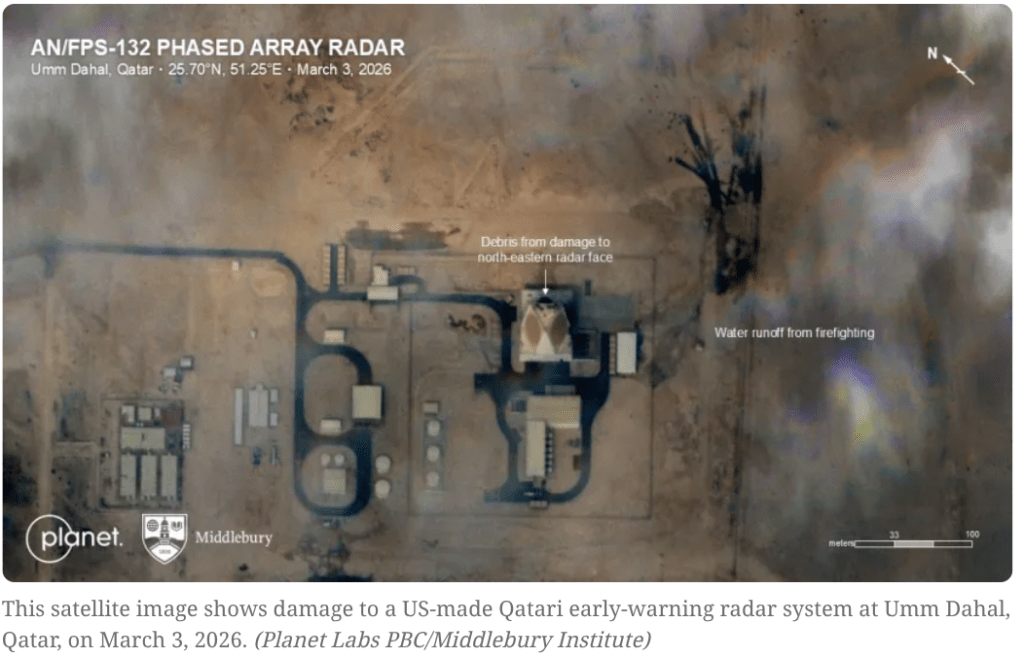
Qatar (Al-Udeid): On March 3, a ballistic missile penetrated one of the most important American air facilities in the region, the multi-billion dollar defense net to strike the AN/FPS-132 Early Warning Radar. This $1.1 billion behemoth was the cornerstone of U.S. tracking for the entire Gulf. It is now partially or fully disabled. (Image Source)
Jordan (Muwaffaq Salti): Satellite imagery from March 2 confirms a blackened, destroyed AN/TPY-2 radar—the heart of the THAAD system (Image Source)

Saudi Arabia (Prince Sultan Air Base): While the Pentagon initially denied hits, March 1 satellite photos show smoke and charred remains at the THAAD radar site. (Image Source)

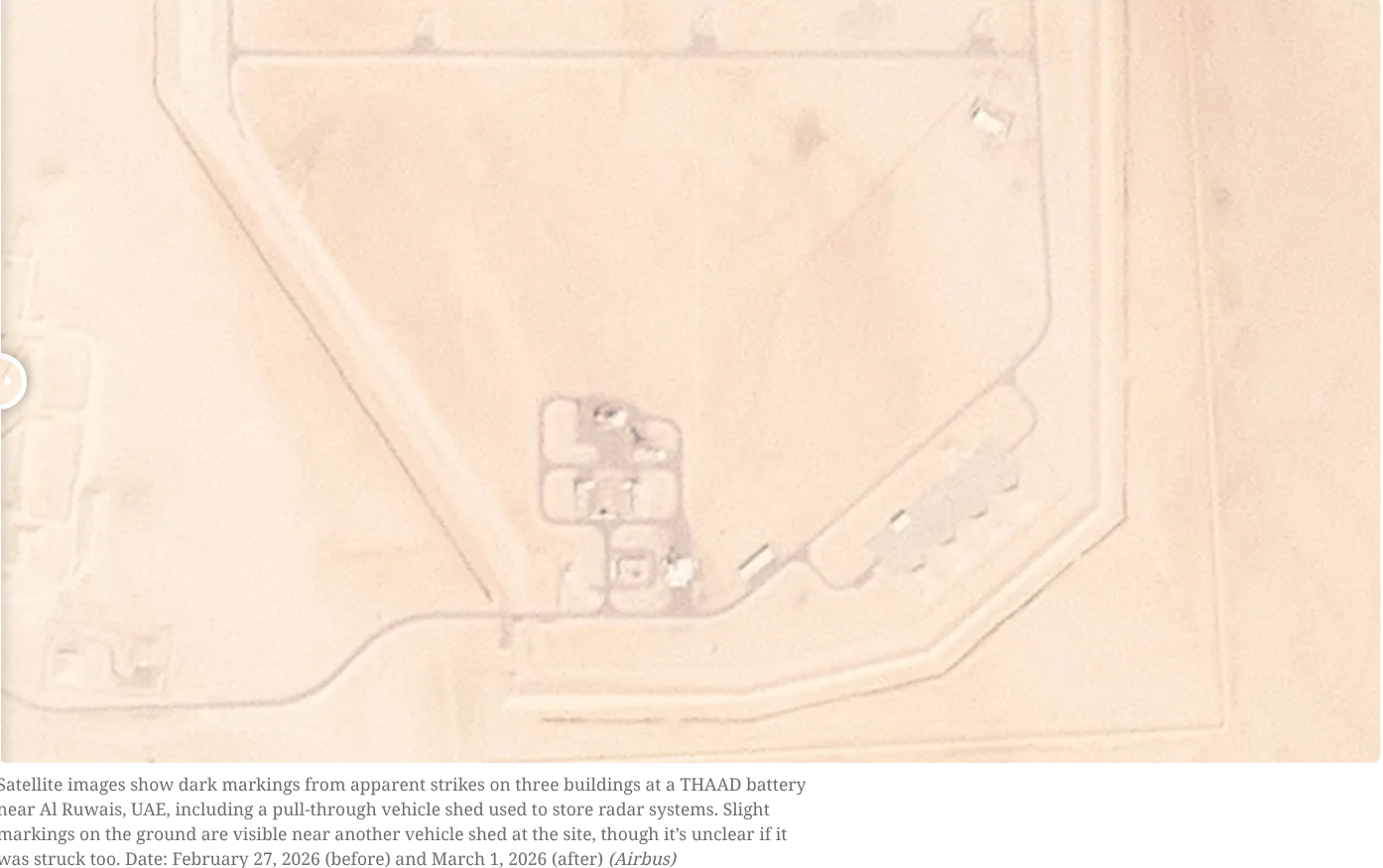
UAE (Al-Ruwais/Sader): Confirmed strikes on radar housing sheds. Slide the arrow left or right to compare the before and after images. (Image Source)


Taken individually, each strike might appear tactical.
Taken together, they point to something more strategic: an attempt to degrade the sensor network that allows the United States to detect and intercept missiles across the Gulf.
The Result: The U.S. is now “flying blind” in key sectors. This is why we see the USS Gerald R. Ford and USS George H.W. Bush being rushed to the region. They aren’t there for “extra power”; they are there because their onboard E-2D Hawkeye planes are the only radars left in the theater; In effect, floating radar stations are now helping fill gaps left by destroyed land installations.
2. The Bahrain Trap: Stranded and Vulnerable
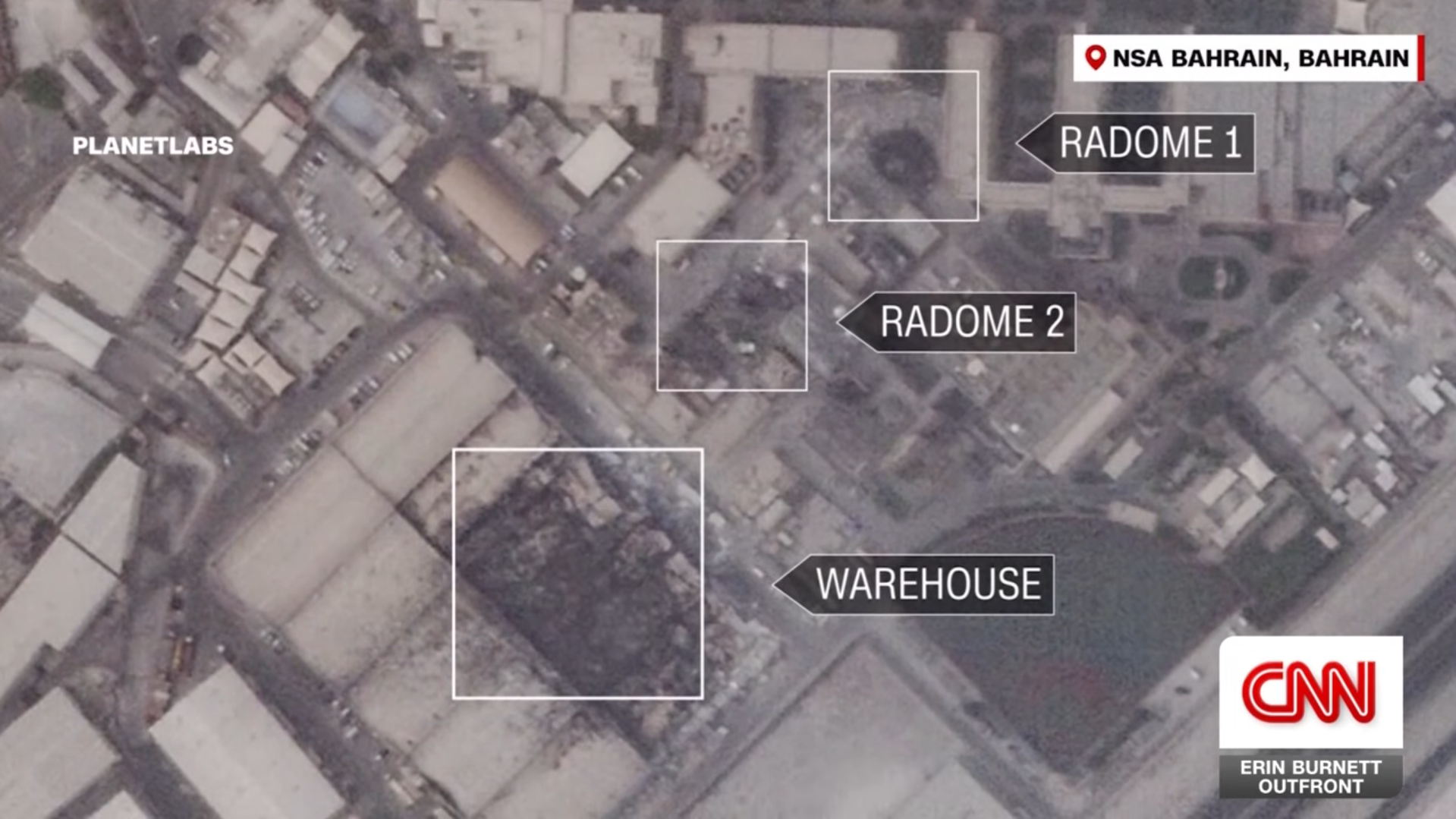
In the first week of March, the war spilled directly into Manama as Iranian drones and missiles struck targets linked to the United States Fifth Fleet. Explosions were reported in districts surrounding the naval headquarters, sending debris and shockwaves across nearby neighborhoods. Buildings in the vicinity—including hotels such as the Crowne Plaza Bahrain and residential towers like Era Views—were reportedly damaged or showered with fragments from interceptions and nearby impacts.
The significance of these strikes lies in what the base represents. The Fifth Fleet headquarters in Manama serves as the central command for U.S. naval operations across the Middle East. From here, the United States oversees maritime security across critical waterways including the Persian Gulf, Gulf of Oman, Red Sea, and the strategic Strait of Hormuz—a chokepoint through which roughly one-fifth of the world’s oil supply passes. Aircraft carriers, destroyers, submarines, and multinational patrols protecting global shipping lanes all operate under this command. In practical terms, the Fifth Fleet is the backbone of American naval power in the Gulf. Yet unlike many military installations, its headquarters sits in the middle of a densely populated capital, surrounded by residential districts and commercial towers.
Slide the arrow towards left and right to see before and after images. (Image Source)

Hostages by Proximity
That geography has created a dangerous reality. Between 5,000 and 7,000 American personnel and family members live in and around the base, many of them now sheltering in place while military targets nearby come under attack. Because the headquarters is embedded within the city, civilians effectively become hostages by proximity—living within range of a battlefield without ever leaving their neighborhoods.
The Evacuation Failure
In response, the U.S. State Department issued a “Depart Now” advisory on March 3. In practice, however, leaving Bahrain has proven far more complicated. Commercial flights through Bahrain International Airport have been repeatedly disrupted, while the surrounding waters of the Gulf have grown increasingly dangerous amid drone activity and reports of Iranian fast boats operating in the region. For many families, the advisory offered little more than a warning without a viable escape route.
The Mercy Factor
For now, those civilians remain alive largely because Iranian strikes appear to prioritize military infrastructure rather than residential housing. But that reality underscores the uncomfortable strategic position Washington faces. Thousands of its own citizens are effectively living within the radius of an active battlefield, their safety depending not on evacuation plans but on the targeting decisions of forces aligned with the Islamic Revolutionary Guard Corps.
Just imagine, if the war is won on the number of bodies as the western media is inhumanely bragging about in Iran, Iran currently has a soft target in Bahrain that could raise the body count to several thousands.
3. The “Lincoln” Retreat: Physics vs. Propaganda
The White House continues to insist that the USS Abraham Lincoln is “unleashing fury” against Iranian targets. Yet the ship’s changing position in regional waters suggests a more cautious reality.
The retreate
On February 28, the carrier strike group was operating in the Gulf of Oman, well within striking distance of Iranian territory. By March 5—after Iranian media claimed a successful missile strike in the area—tracking data indicated that the carrier had repositioned roughly 1,000 kilometers farther south into the deeper waters of the Arabian Sea.
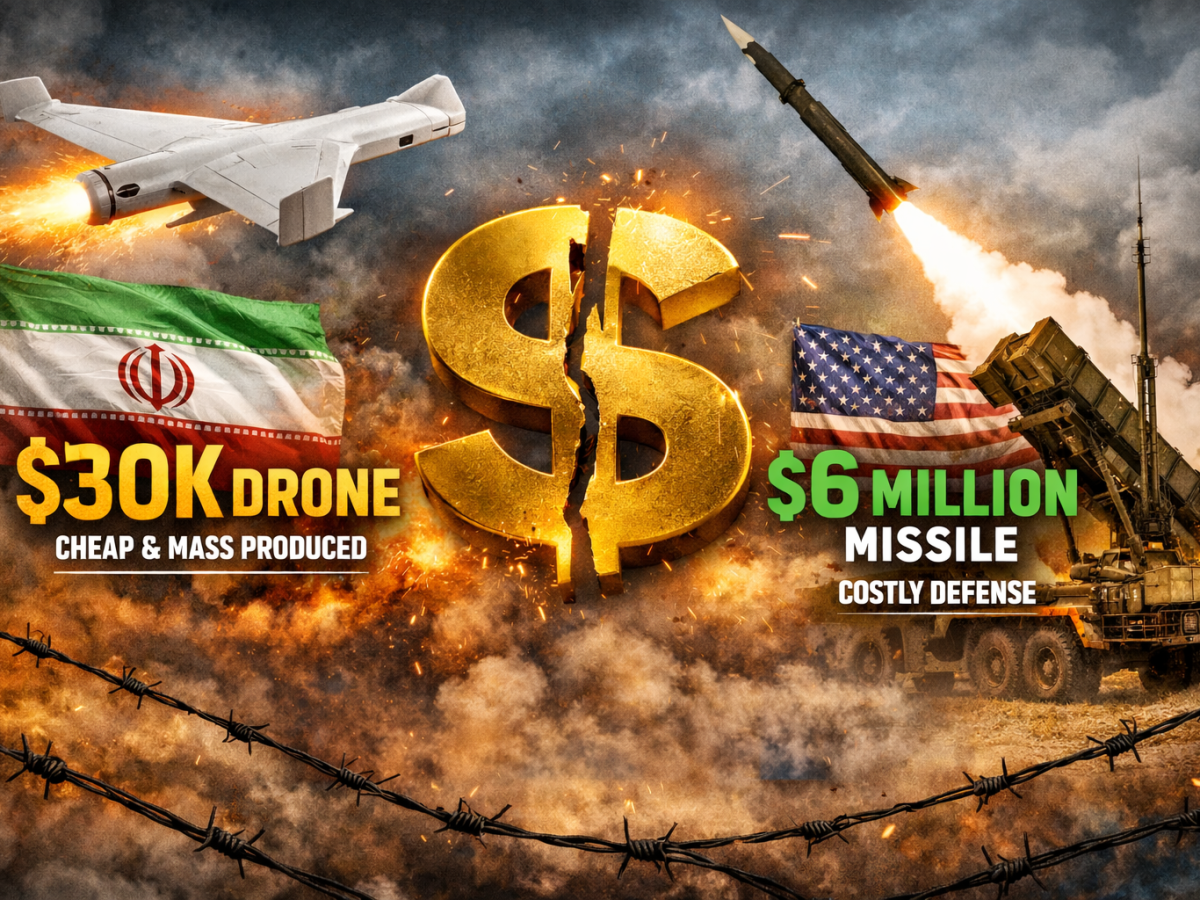
The reason may lie in the mathematics of modern naval warfare. Iran’s strategy relies on saturation—launching large waves of inexpensive drones such as the Shahed-136 alongside ballistic and cruise missiles. Each drone may cost tens of thousands of dollars, but intercepting them requires missiles costing hundreds of thousands or even millions. The carrier itself is protected by escorting destroyers equipped with the Aegis Combat System, but those ships carry a finite number of interceptors.
The Math
Once those interceptor magazines begin to run low, the strategic equation changes quickly. A carrier group facing repeated saturation attacks risks exhausting its defenses long before the attacker runs out of cheap drones and missiles. At that point, even a single advanced weapon—such as Iran’s Fattah—could become a serious threat.
Seen in that context, the carrier’s movement deeper into the Arabian Sea may not simply be a tactical adjustment. It reflects a basic reality of physics and logistics: the closer a carrier operates to a heavily armed coastline, the more vulnerable it becomes to saturation attacks. Distance, in this case, is itself a form of defense.
“Aircraft carriers project enormous power—but only as long as the missiles protecting them last.”
4. The Houthi Lesson: A State is Not a Militia
The administration of Donald Trump entered this war with a familiar assumption: overwhelming American airpower could quickly force an adversary to collapse. That belief had already been tested just months earlier during the confrontation with the Houthi movement in 2025. At the time, Washington launched weeks of intense strikes across Yemen, with Trump publicly boasting that U.S. forces had “bombed the hell out of them.” Yet the outcome told a more complicated story. Even after nearly seven weeks of sustained bombardment, the Houthis continued launching missiles and drones into regional shipping lanes, and the conflict eventually drifted toward a negotiated de-escalation rather than a decisive military victory. Oman brokered the ceasefire between the two belligerents.
If a decentralized militia operating from one of the poorest countries in the region could survive prolonged U.S. airstrikes, the assumption that a heavily fortified state like Iran would collapse within days was always questionable. Iran’s military doctrine relies heavily on deeply buried infrastructure—often referred to as “missile cities”—with launch facilities carved into mountains and reinforced underground complexes designed to survive sustained bombardment.
While U.S. aircraft such as the B-2 Spirit and F-35 Lightning II continue striking Iranian targets, much of that firepower is hitting hardened structures rather than eliminating the launch capability itself. Meanwhile, Iran has relied on large numbers of relatively inexpensive missiles and drones to keep pressure on American defenses. In strategic terms, Tehran appears to be exploiting a familiar asymmetry: forcing the world’s most technologically advanced military to expend extremely costly interceptors against far cheaper weapons.
The Bottom Line
As of March 8, the strategic picture looks far different from the triumphant narrative coming out of Washington.
Several U.S. radar installations across the Gulf appear damaged or degraded, leaving gaps in the early-warning network that once formed the backbone of regional missile defense. Naval forces that initially operated close to Iran’s coastline have shifted farther into the Arabian Sea. Thousands of American civilians remain stranded across Gulf states, including Bahrain, Kuwait, and the United Arab Emirates, with evacuation routes uncertain. Meanwhile, tensions around the Strait of Hormuz—through which a fifth of the world’s oil flows—continue to rattle global markets.
The headlines may still emphasize “successful strikes” in Tehran. But the strategic map suggests something more troubling: a superpower struggling against an adversary that designed its entire doctrine around exploiting American technological advantages. Cheap drones and missiles are forcing the United States to expend vastly more expensive defenses. Infrastructure built over decades is being tested by tactics designed precisely to undermine it.
War narratives are often written in press briefings and social media posts. The battlefield tells a different story.
My Take
The roots of this conflict lie in a political gamble by the administration of Donald Trump. The assumption appeared simple: remove the leadership of Ali Khamenei during ongoing diplomatic maneuvering, trigger internal chaos, and force a rapid collapse of Iran’s governing structure.
Instead, the opposite may have occurred.
The leadership transition appears to have unfolded quickly, suggesting contingency plans were already in place. Rather than fragmentation, Tehran responded with coordinated retaliation across the region.
Which leaves one unsettling question.
If Iran anticipated the possibility of a decapitation strike—and prepared instructions for what would happen next—then the events of the past week may only represent the opening phase of a much longer conflict.
And somewhere in Tehran, long before the first missile was launched, someone may have already written the next chapter.
Thanks for reading! If you learnt something new from the post, hit subscribe and share it with friends and family.
Also read:
- Beyond the Bombing: What Happens After ‘Victory’ is Declared in Iran?
- Pralay Explained: Why the “Apocalypse” Missile is Pakistan’s Strategic Dead End
- The JF-17 Myth: Is Pakistan’s ‘Thunder’ Just a Social Media Success? (Technical Analysis)
- The Russia-Ukraine War: Breeding Ground for Next-Gen Terrorism and a Costly Future
- A Three-Day War That Shook the War Economy







 Infinite Sea of Opportunities
Leave a comment