
The Wake of Operation Sindoor: A Stark Reality Check
Operation Sindoor (May 2025) was a masterclass in modern warfare—India’s precision strikes on terror camps in Pakistan, executed in a single night, inflicted significant damage without crossing into a full-scale war. The ceasefire followed swiftly, but the operation exposed a glaring gap in India’s arsenal: the absence of fifth-generation fighter jets with stealth capabilities. As soon as the dust settled, defense specialists across newspapers, online platforms, and vlogs began sounding the alarm—India must procure fifth-generation jets, and fast. The Advanced Medium Combat Aircraft (AMCA), India’s indigenous fifth-generation project, is moving at a glacial pace, with a projected timeline of 2035. This delay has led experts to argue that India should buy from abroad to bridge the gap.
Also read: Operation Sindoor: Pakistan’s Pathetic Collapse—India Crushed It, and It’ll Do It Again
The ongoing Aero Show in Bengaluru (May 2025) has only amplified these concerns. Russia and the USA are showcasing their fifth-generation jets—the Su-57 and F-35, respectively—both boasting stealth capabilities (Su-57 RCS: 0.5-1 square meters; F-35 RCS: 0.0001 square meters) that India’s current fleet (Rafale, Su-30 MKI) can’t match. Meanwhile, reports suggest Pakistan is set to procure 40 of China’s J-20 fifth-generation jets by 2029, with China already fielding 250+ J-20s near the LAC. The message is clear: India is falling behind in a high-stakes aerial arms race. Staying ahead isn’t just a matter of pride—it’s a strategic imperative to counter China’s growing dominance and Pakistan’s ambitions (e.g., J-35A plans by 2029).
The Costly Race of Playing Catch-Up
This race to stay in line with global powers is proving costly—and it’s a financial drain India can ill afford. Procuring fifth-generation jets like the F-35 (offered to India in 2025) or Su-57 would cost billions—$80-100 million per jet, excluding maintenance and infrastructure. If AMCA continues to lag, India will keep hemorrhaging funds on imports, diverting resources from other critical areas like cyber warfare and drone technology, which proved decisive in Operation Sindoor. The real solution lies in making these jets at home, but India’s defense ecosystem is stuck in a rut, and the reasons are deeper than just technological delays.
What Are China, Russia, and the USA Doing Differently?
To understand India’s predicament, let’s compare its defense spending with that of China, Russia, and the USA. Russia’s economy (GDP $1.8 trillion, 2024) is comparable to India’s ($3.5 trillion), and China’s economy was on par with India’s not long ago (1990s: $400 billion each). The USA, with its centuries of economic dominance ($27 trillion GDP, 2024), has an obvious upper hand, but the spending patterns of these countries reveal a stark contrast with India.
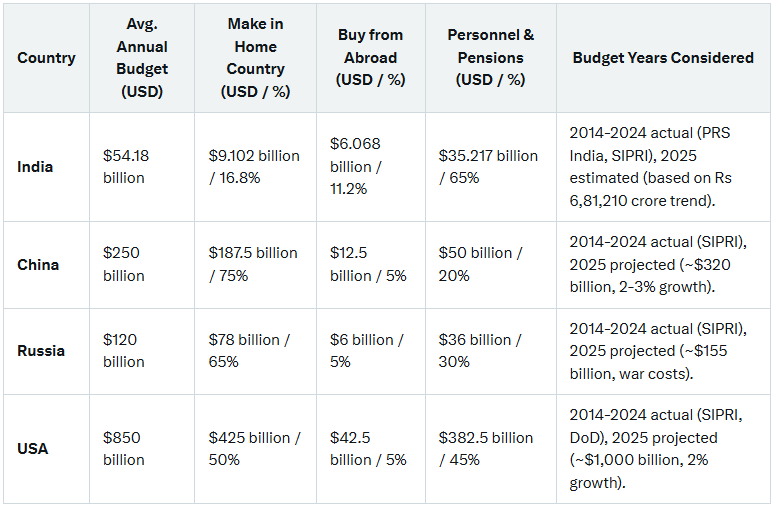
I analyzed the defense budgets of India, China, Russia, and the USA over the period 2014-2025, averaging the annual spending across these 12 years to capture trends like India’s Make in India push (2014), OROP (2015), and Agnipath (2022), as well as global shifts like China’s J-20 expansion. I split the budgets into three categories: Make in Home Country (R&D, production), Buy from Abroad (imports), and Personnel and Pensions. The data, presented in USD for consistency, paints a damning picture of India’s priorities.
Additional Notes:
- Budget Years Details: The figures are averages over 2014-2025. For India, data from 2014 (Rs 2,29,000 crore) to 2024 was sourced from PRS India and SIPRI, with 2025 estimated using the 2025-26 budget (Rs 6,81,210 crore). China’s 2014 budget ($190 billion) to 2024 ($314 billion) came from SIPRI, with 2025 projected at ~$320 billion (2-3% growth). Russia’s 2014 ($90 billion) to 2024 ($149 billion) data is from SIPRI, with 2025 at $155 billion (war-driven). The USA’s 2014 ($780 billion) to 2024 ($997 billion) is from SIPRI/DoD, with 2025 at ~$1,000 billion (2% growth).
- India’s Remaining 7%: India’s percentages sum to 93% (16.8% + 11.2% + 65%), with the remaining 7% ($3.793 billion) attributed to operational costs (e.g., maintenance, civil defense), as noted in prior analyses.
- Accuracy: Figures were cross-checked with SIPRI and web sources (e.g., web ID: 17). India’s USD conversion uses Rs 84/$1, consistent with the 2025 context.
The Elephant in the Room: India’s Personnel Burden
India’s defense spending reveals a harsh reality: 65% of its budget goes to personnel and pensions, dwarfing the 16.8% allocated for R&D and production. This imbalance—driven by a 1.4 million-strong army, OROP (2015), and pay commissions—has worsened over decades, rising from 60% in 1975-1990 to 65% by 2014-2025. With such a small fraction left for tech development, India struggles to fund projects like the AMCA, which limps along with a meager budget, while critical systems like Rafale jets and S-400 defenses must be imported.
Operation Sindoor (May 2025) proved the primacy of technology in modern warfare. No jets crossed borders, and dogfights were absent—Pakistan’s claims of downing Rafales lack evidence and defy logic given the operation’s stealth nature. India’s success stemmed from high-tech electronic warfare, using drones like Israel’s Harop, precision strikes, and cyber operations to neutralize Pakistan’s 300-400 drones without risking pilots. The lesson is undeniable: tech superiority, not troop numbers, wins battles. Fifth-generation jets like China’s J-20 or the USA’s F-35 are the future, and India is lagging.
Compare India’s approach to global powers, and the contrast is stark. China slashed its personnel share from 40% in 1975-1990 to 20% by 2025, channeling 75% of its budget into domestic production. This focus has yielded 250+ J-20s and Type 055 destroyers, with a PPP-adjusted budget rivaling the USA’s non-personnel spending. Russia, despite an economy comparable to India’s, reduced its personnel share to 30%, enabling 65% domestic production that delivered the Su-57 and S-500 systems—even under sanctions. The USA, with a 45% personnel share, still dedicates 50% to domestic production, maintaining tech dominance with the F-35 and B-21 Raider.
India’s 65% personnel burden, by contrast, starves innovation. The AMCA’s limited funding pales against China’s massive R&D investments, leaving India vulnerable to China’s J-20s along the LAC and Pakistan’s J-35A ambitions by 2029. Forced to rely on imports to plug gaps, India’s defense strategy is a losing battle unless it shifts focus to technology over troops.
The Urgent Need for Reform: Slash Personnel Costs, Boost Tech
India must slash its 65% personnel share to align with global leaders—aim for 30% like Russia, or even 20% like China. This would free up over $20 billion annually for R&D, tech, and equipment, accelerating AMCA and developing sixth-generation capabilities (expected by 2030 globally). Or the other way to look at it is increase the spending on tech without increasing any more spending on personnel i.e. keeping personnel spending at the current value. The Agnipath scheme (2022) was a step in this direction, aiming to reduce pension costs by recruiting soldiers for four years, retaining only 25% permanently. India can’t wait—China’s J-20s are already on the LAC, and Pakistan’s J-20 procurement looms.
Congress’s Opposition: A Betrayal of National Interest
Yet, in a shocking display of political opportunism, Rahul Gandhi and the Congress party continue to oppose Agnipath, prioritizing electoral gains over national security. Congress has called Agnipath “anti-national” and “anti-youth,” demanding its rollback since 2022. Their 2024 manifesto promised to “scrap the Agnipath Scheme and return to normal recruitment processes,” ignoring the pension crisis (Rs 1,60,795 crore in 2025-26). Rahul Gandhi labeled Agnipath an “insult” to youth, claiming it was “made in Narendra Modi’s office” to save pensions and benefit industrialists like Adani (Business Today, 2024). Deepender Singh Hooda called it a “big failure” post-2024 elections, demanding a white paper (India Today). This rhetoric undermines a critical reform, risking a return to 70%+ personnel costs—further delaying AMCA while China and Pakistan advance.
Rahul Gandhi’s attacks extend beyond Agnipath—he and Congress perpetuate a communist mindset that government institutions like HAL and DRDO should do everything. The F-35 and F-16 are built by Lockheed Martin (USA), a private company; Rafale by Dassault Aviation (France), another private firm. Yet, when India’s private sector—e.g., Adani (Hermes-900 drones with Elbit) or Tata—steps into defense, Congress cries “crony capitalism.” Rahul Gandhi’s 2024 claim that Agnipath benefits “Modi’s industrialist friends” like Adani (who’s exporting drones to Israel) ignores the reality: private companies drive innovation globally. HAL’s delays (Tejas Mk-1A slipped to 2024) and DRDO’s failures (Kaveri engine) show the public sector’s limits. India needs private involvement—yesterday—to catch up in the tech race.
The Hard Truth: India’s Defense Strategy Is a Dinosaur
India’s defense strategy is a relic—65% on personnel while China spends 20%, Russia 30%, and the USA 45%. Operation Sindoor proved tech wins wars, not troop numbers, yet India clings to a personnel-heavy model. AMCA’s delays and import reliance (11.2%) leave us exposed to China’s 250+ J-20s and Pakistan’s J-20 plans. Congress’s opposition to Agnipath and private sector involvement is a betrayal of national interest, rooted in vote-bank politics and an outdated communist mindset. If India doesn’t slash personnel costs, boost R&D, and embrace private companies, we’ll keep bleeding funds on imports while our adversaries soar ahead with sixth-generation jets by 2030. The Bengaluru Aero Show isn’t just a display—it’s a wake-up call. Will India rise, or remain a spectator in its own defense story?
Thanks for reading! If you enjoyed reading the article, please do subscribe to the blog as I am currently writing some more on the similar lines completing my
Thanks for reading! If you enjoyed this article, please subscribe to the blog—I’m currently working on more pieces along these lines, diving deeper into India’s defense challenges and strategic reforms, as I complete my ongoing research. Your support will help fuel this critical conversation.
Must read:








 Infinite Sea of Opportunities
Leave a comment