
On May 10, 2025, with tensions simmering along the Line of Control, Pakistan launched its much-anticipated retaliatory strike—Operation Bunyan al-Marsous; an ambitious counteroffensive named after a Quranic verse symbolizing a “solid structure” or “wall of lead.”
The objective was chillingly simple: hit at least one Indian military site. Not to win a war or gain tactical advantage, but to score a symbolic victory, powerful enough to show its people that Pakistan had delivered an equally damaging reply to India’s Operation Sindoor, a response to the April 22 Pahalgam terror attack that killed 26 Hindu tourists. But the operation failed. Miserably! None of the missiles launched could penetrate India’s robust, multi-layered defense shield, bolstered by Akash, Akashteer, and S-400 systems. This wasn’t just a tactical failure; it was a strategic embarrassment, exposing the limits of Pakistan’s arsenal and leaving the nation at a crossroads.
The Pillars of Pakistan’s Missile Program
Pakistan has poured billions of borrowed dollars into its missile arsenal, prioritizing military might despite a fragile economy. The three pillars of its doctrine are:
- Shaheen Series
- Types: Shaheen-I, Shaheen-II, Shaheen-III
- Range: 750 km (Shaheen-I) to 2,750 km (Shaheen-III)
- Speed: High-supersonic, estimated > Mach 5
- Purpose: Designed for fast-strike nuclear or conventional delivery, targeting deep into India, including the Andaman and Nicobar Islands.
- Cost: Analysts estimate $15–20 million per missile, with total program costs in the billions.
- Estimated Number: Likely dozens, possibly 100+ units, inferred from test frequency and production hints.
- Shaheen-III was a point of pride, flaunted in propaganda as a counter to India’s distant strategic assets.
- Fateh Series
- Type: Tactical ballistic missiles, Fateh I and Fateh II
- Range: 140 to 400 km
- Speed: Subsonic to supersonic, varying by configuration
- Purpose: Battlefield support, targeting Indian formations near the border
- Cost: Approx. $1–2 million per unit
- Estimated Number: Likely several hundred, based on deployment patterns
- Designed for precision, their utility wanes against India’s air superiority and interception systems.
- Babur Cruise Missile
- Type: Subsonic cruise missile
- Range: 450 to 700 km
- Speed: Around 880 km/h
- Purpose: Terrain-hugging strikes against fixed targets
- Cost: Estimated $2–5 million per missile
- Estimated Number: Likely 100–150 units
- Billed as a “Pakistani Tomahawk,” it aimed for stealth and accuracy but faltered in Operation Bunyan al-Marsous.
The Great Collapse: A Humiliating Outcome
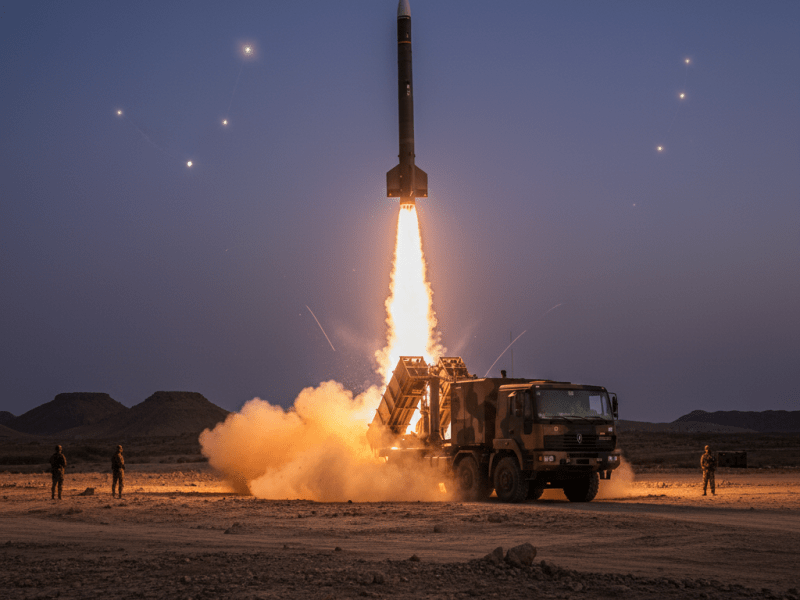
On May 10, 2025, Pakistan launched Operation Bunyan al-Marsous, firing a salvo of roughly 30 missiles—Shaheen for deep strikes, Fateh for border targets, and Babur for evasive hits—alongside dozens of drones. Targets included Indian air bases at Udhampur, Pathankot, Sirsa, and Adampur, plus BrahMos storage sites in Beas and Nagrota, aiming to disrupt military assets across northern and western India. Pakistan’s state media claimed hits, even alleging an S-400 system in Adampur was destroyed. But India’s multi-layered defense crushed these hopes. The Prithvi Air Defence (PAD) and Advanced Air Defence (AAD) of India’s Ballistic Missile Defence (BMD) intercepted high-altitude threats. The Akash SAM, with a 25–70 km range and 60 kg warhead, neutralized drones and low-flying missiles. Akashteer, an AI-driven control system, fused radar and sensor data for real-time tracking, guiding interceptors with precision. The S-400 Triumf, a Russian long-range system, engaged ballistic threats, downing Shaheen missiles before they neared critical sites. Indian officials released time-stamped images, showing minimal damage—debris near Udhampur and Pathankot, but no direct hits. By 9:30 a.m., with no penetration, Pakistan sought a ceasefire via DGMO hotline talks, mediated by the U.S.
Pakistan’s Dilemma: What Now?
This was more than a failed strike; it was a psychological blow to a military long focused on countering India, leaving its billion-dollar arsenal—Shaheen-III included—exposed as ineffective against modern defenses. The illusion of a second or third strike capability shattered, forcing a nation to face its strategic limits. The reality is harsh. Pakistan now finds itself sitting on a pile of expensive fireworks. Missiles meant to neutralize India’s strategic bases, is now proven ineffective in the face of modern defense systems. With terrorism surging inside the country and India controlling the seas and skies, Pakistan now finds itself between the devil and the deep blue sea.
The Devil: Pakistan’s Terror Nexus
Pakistan’s decades-long ties to militant groups like Jaish-e-Mohammed (JeM) and Lashkar-e-Taiba (LeT), behind the April 22, 2025, Pahalgam attack killing 26 in Indian-administered Jammu and Kashmir, are woven into its societal fabric. Initially state-backed for proxy wars against India, these groups now run charities, schools, and relief efforts, embedding themselves in communities from Balochistan to Khyber Pakhtunkhwa. To fight this “devil,” Pakistan must overhaul its foundations—reforming education, madrassas, and military dominance—but even a miraculous ideological shift may not dismantle the terror nexus without destabilizing civil society.
JeM and LeT, born from the 1980s Afghan jihad and redirected toward Kashmir, gained footholds through social services, like LeT’s aid post-2005 earthquake. Their funding, often via hawala or Gulf donors, supports local economies, making them hard to uproot. To counter this:
- Education: Textbooks glorifying jihad need replacing with curricula fostering tolerance, a costly, decades-long task.
- Madrassas: Over 35,000, some linked to militancy, require oversight and standardized curricula, facing cleric resistance.
- Military: Curbing the ISI’s influence demands civilian empowerment, challenging deep-rooted prestige.
Even if Pakistan rewires its ideology, JeM and LeT’s ties to communities and businesses persist, per 2023 FATF reports on terror financing. Raids and arrests risk protests, economic fallout, and insurgency, threatening “near-total upheaval” of a society already strained by debt and unrest. Targeted operations, like post-2014 Peshawar, haven’t stopped JeM’s resurgence. A full crackdown could alienate millions, while inaction invites more attacks. Pakistan’s war on terror is unwinnable without reform, yet dismantling this nexus may tear the nation apart—a reckoning it may not survive.
The Deep Blue Sea: India and Its Ocean
In 1965, Zulfikar Ali Bhutto vowed, “We will eat grass, even go hungry, to get our own [nuclear bomb],” signaling Pakistan’s resolve for parity with India. Today, that determination faces a steeper test—not just a bomb, but a missile defense system to rival India’s shield. Building a robust defense demands decades of R&D, in-house engineering, and vast capital, far beyond procuring advanced weapons. India’s Ballistic Missile Defence (BMD), with Phase 1 operational and Phase 2 ongoing, took over 20 years and billions. Pakistan, burdened by $130 billion in debt and $30 billion due by June 2026, risks economic collapse, echoing the Soviet Union’s 1980s overreach.
To counter India’s defenses, Pakistan must modernize with electronic warfare (EW):
- Decoys & Jamming: Disrupt radars like Akashteer or S-400 with AI-driven false targets and frequency-hopping signals.
- Hypersonic Glide Vehicles: Evade interceptors at Mach 5+, a costly technological leap.
- Stealth Coatings: Minimize radar signatures using advanced materials, requiring millions in R&D. Such upgrades demand $500 million for development and $2–5 million per missile. Western suppliers, wary of geopolitics, may decline, while China, supplying 80% of Pakistan’s defense, offers cheaper but less autonomous tech.
Diversifying risks alienating China, a vital ally via CPEC, yet sole reliance limits strategic freedom. Indigenous engineering—slow and expensive—is critical but elusive. With a battered economy, IMF oversight, and soaring inflation, funding is a fantasy. More loans deepen the debt trap; printing dollars isn’t viable. Without a windfall—oil, tech, or geopolitics—Pakistan’s defense ambitions teeter, forcing a choice: sacrifice more or rethink its rivalry with India.
Conclusion: Pakistan at the Crossroads
Pakistan’s Operation Bunyan al-Marsous, launched on May 10, 2025, was a military debacle with profound political and strategic repercussions. Its failure to penetrate India’s multilayered defense—Akash SAM, Akashteer, S-400, and BMD—laid bare a hollow offensive doctrine, unable to match India’s technological edge. In the short term, Pakistan resorts to silence, a ceasefire, and propaganda to mask the humiliation. Long-term, it faces an existential bind: confront the “devil” of terrorism or the “deep blue sea” of India’s dominance. Both paths demand resources—minds, engineers, trust, time—that Pakistan is fast losing.
The “devil” within—militant groups like JeM and LeT—fuels internal unrest, with 2025 attacks rising in Balochistan and Khyber Pakhtunkhwa. Dismantling this nexus risks civil turmoil, threatening fragile social cohesion. The “deep blue sea”—India’s military and maritime superiority—exposes Pakistan’s vulnerabilities, as May 10’s failure showed. Yet, Pakistan’s focus remains external. On May 28, 2025, celebrating the 27th anniversary of its 1998 nuclear tests, dubbed “Youm-e-Takbeer,” leaders reaffirmed their commitment to nuclear strength, signaling a resolve to counter India over reforming internally. This choice—prioritizing bombs over stability—edges Pakistan closer to chaos. Modernizing missiles with EW or building a BMD demands billions, unfeasible with $130 billion in debt and $30 billion due by June 2026. Reliance on Chinese tech deepens dependency, while internal neglect fuels militancy. Pakistan can buy weapons, but true security requires a reckoning with its demons—a shift it seems unprepared to make, risking further shame or collapse.
Thanks for reading! Please do share the article and don’t forget to let me know your thoughts in comments.
Also read:









 Infinite Sea of Opportunities
Leave a comment