
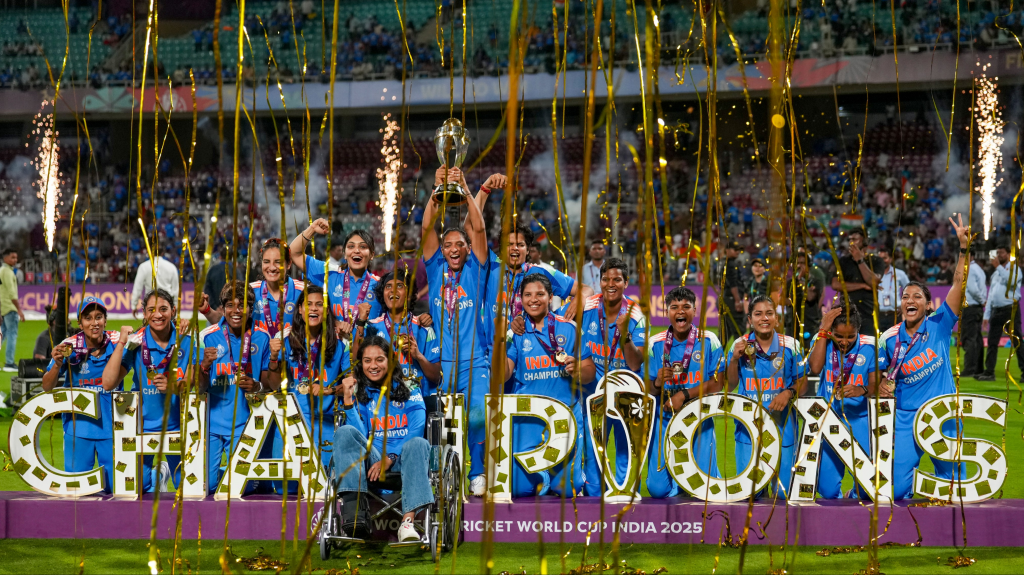
The ICC Women’s Cricket World Cup 2025 was nothing short of a national epiphany. On November 2, 2025, in a finale that gripped the country like no other, the Indian women’s team etched their name in golden letters by winning their first-ever World Cup title, defeating a resilient South African side in a nail-biting contest that went down to the wire. The stadiums in Bengaluru, Delhi, Lucknow, Ahmedabad, and Dharamshala were not just filled—they were electrified. Fans poured in by the tens of thousands, with venues like Navi Mumbai recording over 25,000 attendees for group-stage matches alone, shattering every previous benchmark for women’s cricket attendance in India. The final alone drew a staggering 190 million viewers across television and digital platforms—making it the most-watched women’s sporting event in Indian history. This wasn’t just a tournament. It was a 34-day saga of sweat, strategy, sacrifice, and sheer willpower—a living testament to women breaking through glass ceilings in a sport long monopolized by men. And in the center of it all stood players like Jemimah Rodrigues, whose infectious energy, fearless strokeplay, and unapologetic joy turned her into the nation’s new crush, a symbol of the modern Indian woman who dares to dream, dominate, and dazzle.
Yet, in this moment of collective pride, one group was conspicuously, unforgivably absent: the so-called vocal feminists of India. Where were they? The self-proclaimed torchbearers of women’s liberation—Swara Bhasker, Barkha Dutt, Taapsee Pannu, Deepika Padukone, Priyanka Chopra, Kavita Krishnan, Brinda Karat, (add the names that I missed) and an army of social media influencers who never miss a chance to lecture the nation on patriarchy—were nowhere to be found. Not in the stands. Not on the field. Not even on their phones. They weren’t cheering from the galleries with handmade posters. They weren’t posting Instagram Reels celebrating Harmanpreet Kaur’s leadership or Smriti Mandhana’s elegance. They didn’t drop a single X thread analyzing the cultural significance of India’s victory. Exhaustive searches across X (formerly Twitter), Instagram, YouTube, and web archives from September 30 to November 3, 2025, reveal zero substantive engagement from any of these high-profile feminist voices. The only mentions? Two fleeting text posts from obscure accounts—hardly the amplification one expects from a movement that claims to fight for women’s visibility.
Worse still: when online trolls unleashed a torrent of misogynistic abuse—mocking Mandhana and Kaur with “go back to the kitchen” after early losses, and even targeting Jemimah Rodrigues with vile comments during the final—the feminist brigade offered nothing. No outrage. No solidarity posts. No hashtag campaigns. Respected voices like Aakash Chopra called out the sexism publicly. Former players and journalists condemned the hate. But the feminists? Radio silence. This wasn’t a minor lapse. This was a systemic failure—a refusal to stand with women when it mattered most.
And that’s where the hypocrisy becomes unmistakable.
Let’s contrast this silence with the Sabarimala movement of 2018–2019. For months, feminists mobilized thousands across Kerala and beyond. They marched. They protested. They defied police barricades. They faced violent backlash from conservative groups. Women like Bindu Ammini and Kanakadurga risked their lives to enter the Sabarimala temple during their menstrual cycles, challenging a centuries-old ban. The movement dominated headlines, sparked global debates on religious freedom, gender equality, and bodily autonomy, and became a rallying cry for progressive activism. It was bold, confrontational, and unapologetic—exactly the kind of high-drama, high-visibility activism that Indian feminists seem to thrive on.
But let’s ask the hard questions:
- Why force entry into a temple if you reject its rituals?
- If you don’t believe in the deity or the tradition, why not just walk away?
- What did this achieve for the average Indian woman?
Five years later, the answers are sobering. The Sabarimala agitation affected a tiny fraction of devout Hindu women. It did nothing to reduce period poverty in rural India. It didn’t improve access to sanitary pads in government schools. It didn’t challenge workplace discrimination, dowry violence, or female foeticide. It deepened social and political divides without delivering tangible gains for women’s daily lives. Yet feminists poured blood, sweat, and media cycles into it like it was the final battle for liberation.
Meanwhile, a month-long global celebration of women’s athletic excellence—one that directly empowered millions of young girls, broke stereotypes, and proved women belong at the pinnacle of sport—was met with total indifference.
Now imagine if even 10% of that Sabarimala energy had been redirected to the World Cup. The opportunities for meaningful feminist discourse were endless.
Take menstrual health in sports—a topic ripe for advocacy. Scientific studies show that menstruation significantly impacts female athletes:
- Increased fatigue due to blood loss and hormonal shifts
- Higher injury risk from ligament laxity during certain cycle phases
- Performance dips in endurance, strength, and focus
These challenges are magnified in a 34-day tournament with back-to-back matches, travel, and pressure. Jhulan Goswami, one of India’s greatest fast bowlers, has spoken openly about managing periods on tour: “It’s not an excuse, but it’s real. You need better facilities, understanding, and support.” The ICC itself highlighted this in 2025, revealing through surveys that 33% of female cricketers feel their performance is affected by their cycle. They launched webinars, research initiatives, and policy recommendations to address it.
I’ve played 50-over cricket. It’s brutal—physically and mentally. Running between wickets for hours, bowling 10 overs in scorching heat, fielding. But I can’t even imagine how difficult it would be doing all that with debilitating cramps, bloating, and nausea. How do you maintain focus, power, and precision when your body is fighting itself? How do you perform at your peak on Day 2 of your period, when you’re barely standing? These women didn’t just play—they dominated. They won a World Cup. And they did it while navigating biological realities that no male athlete will ever face.
This should have been feminist catnip. They could have:
- Created viral Reels praising the players’ resilience
- Launched #PeriodPowerInSport campaigns
- Demanded better menstrual hygiene facilities in stadiums and training centers
- Celebrated how these athletes redefine strength
Instead? Nothing. A person like me who does not call himself a feminist has to step in and say: Kudos to these warriors. You acted superhuman.
This omission isn’t random. It’s symptomatic.
Modern Indian feminism has become a selective, elite club. It picks fights that generate outrage and headlines—temple entries, nudity as rebellion, “my rules” slogans—but dodges the grind of real empowerment.
It tears down without building up. It disrupts traditions without offering viable alternatives. And in doing so, it alienates the very people it claims to represent.
Men feel vilified. Traditional women feel erased. Moderate voices self-censor, terrified of being labeled “anti-feminist.” Society fractures further.
The World Cup could have been a unifying moment—celebrating equal pay (achieved in 2022), reclaiming public spaces, and inspiring the next generation. Instead, feminist absence reinforced the stereotype that women’s achievements are secondary, less worthy of attention.
Now let’s talk celebrity feminism—the most toxic strain.
Swara Bhasker will rant about Bollywood sexism for days. But where is she when item songs—those plotless, skin-flaunting, male-gaze-pandering sequences—dominate every blockbuster? Scholars have linked item numbers to objectification, body image issues, and even sexual violence. Yet feminist actresses perform in them, defend them, and profit from them.
Look at leading actresses. Spare Vidya Balan, Kangana Ranaut, and Rani Mukherjee—women who’ve carried films on acting alone. The rest? Success often hinges on:
- Provocative dances
- Steamy scenes
- Hero’s star power
Where is the feminist demand for role-reversed films? For women-led action sagas? For scripts where men are the love interests and women save the day?
Is Indian feminism now just nudity marketed as liberation? Promiscuity sold as empowerment?
This isn’t the feminism of Savitribai Phule, who risked her life to educate girls when society shunned it. That was substantive. Transformative. Enduring.
Today’s version? A performative echo chamber.
- Noise over action
- Chaos over construction
If feminists truly cared, they would have:
- Filled stadiums with banners
- Amplified athletes on every platform
- Crushed trolls with coordinated campaigns
- Initiated periods talk in sports
They didn’t. They won’t. Because real change is hard. Headlines are easy.
They’re not leaders. They’re obstacles.
But here’s the silver lining—and it’s a big one: Not everyone who fights for women calls themselves a feminist.
The real heroes don’t need labels. They don’t need validation. They show up. They build. They celebrate.
The Women’s Cricket World Cup 2025 proved it. Millions cheered. Girls dreamed. India changed.
True empowerment doesn’t shout “feminism.” It just wins.
Thank you for reading!!
Also read:





 Infinite Sea of Opportunities
Leave a comment