
While Indian news cycles remain fixated on the box office success of Dhurandhar or the winter fog in Delhi, a historical tragedy is being rewritten across our eastern border.
December 25, marked the return of Tarique Rahman to Dhaka after 17 years in exile. As he steps onto the tarmac to the cheers of thousands, the air in Bangladesh is thick with a strange, paradoxical energy. The same Gen-Z that toppled one dynasty in 2024 is now marching alongside another dynasty and more importantly alongside forces like Jamaat-e-Islami, shouting anti-India slogans, and—most shockingly—reclaiming a slur that once meant a death sentence: “Razakar.”
To the youth on the streets of Dhaka, “Razakar” is a middle finger to the ousted Sheikh Hasina. But to anyone who knows the history of 1971, it is a chilling echo of a Nazi-level holocaust that this new generation seems to have either forgotten or never been taught.
How It All Began: A Democracy Denied
To understand why the streets of Dhaka are once again stained with blood, one must look back to 1970—the year democracy was born in Pakistan, only to be strangled in its crib by the West Pakistani elite.
The 1970 Elections: The Mandate of the People
In December 1970, Pakistan held its first-ever general elections. For the first time, the principle of “one man, one vote” was applied. Sheikh Mujibur Rahman, the leader of the Awami League (AL) and the charismatic father of Sheikh Hasina, campaigned on a “Six-Point” platform for provincial autonomy.
The results were a seismic shock to the West Pakistani establishment:
- The Awami League won 160 out of 162 seats in East Pakistan.
- This gave Mujib an absolute majority in the 300-seat National Assembly.
- Legally and morally, Mujibur Rahman was the Prime Minister-elect of all Pakistan.
The West Pakistani leadership—led by President Yahya Khan and the ambitious Zulfikar Ali Bhutto—refused to accept a Bengali as their leader. To them, the Urdu-speaking West was the “true” Pakistan; the Bengali East was merely a colony.
Negotiations were a smokescreen. While Mujib sat at the table in Dhaka trying to find a political solution, West Pakistan was secretly moving troops and ammunition into the East. On March 7, 1971, sensing the impending trap, Mujib delivered his iconic speech at the Racecourse Ground: “The struggle this time is the struggle for our emancipation! The struggle this time is the struggle for our independence!”
The Nine Months of Hell: From Searchlight to Surrender
On the night of March 25, 1971, the Pakistani Army launched Operation Searchlight. It was not a battle; it was a massacre. If we go by official Bangladeshi estimates, close to 3 million people were killed. However, International/Independent Estimates give a range from 300,000 to 1.5 million deaths.
The army targeted Dhaka University, systematically executing students and professors in their dorms. Mujibur Rahman was arrested and flown to a prison in West Pakistan. Before his arrest, he sent out a final telegram declaring Bangladesh independent—a message that sparked the Mukti Bahini (Freedom Fighters) into action.
For the next nine months, the Pakistani Army and their local collaborators—the Razakars, Al-Badr, and Al-Shams (the paramilitary wings of Jamaat-e-Islami)—unleashed a reign of terror.
Just two days before their final surrender, the Al-Badr death squads rounded up hundreds of Bengali doctors, writers, and engineers, executing them and dumping their bodies in the brick kilns of Rayer Bazar. They wanted to ensure that if Bangladesh became free, it would be a nation without a brain.
Between 200,000 and 400,000 women were victims of genocidal rape. The Pakistani commanders explicitly ordered their soldiers to “impregnate” Bengali women to “purify” the race with “true Muslim genes.”
When today’s Gen-Z chants, “Who are you? Who are we? Razakar! Razakar!”, they are unknowingly wearing the uniform of the very men who guided the army to the doorsteps of Bengali intellectuals, doctors, and students to execute them in cold blood.
1971: Why India Had to Step In
The current anti-India rhetoric in Dhaka paints India as a “puppet master.” But in 1971, India’s involvement was a matter of survival.
By late 1971, 10 million refugees had flooded into West Bengal, Assam, and Tripura. India was facing a demographic and economic collapse.
The US, under Nixon and Kissinger, ignored the stacks of bodies in Dhaka because they needed Pakistan as a bridge to fight against Soviet Union.
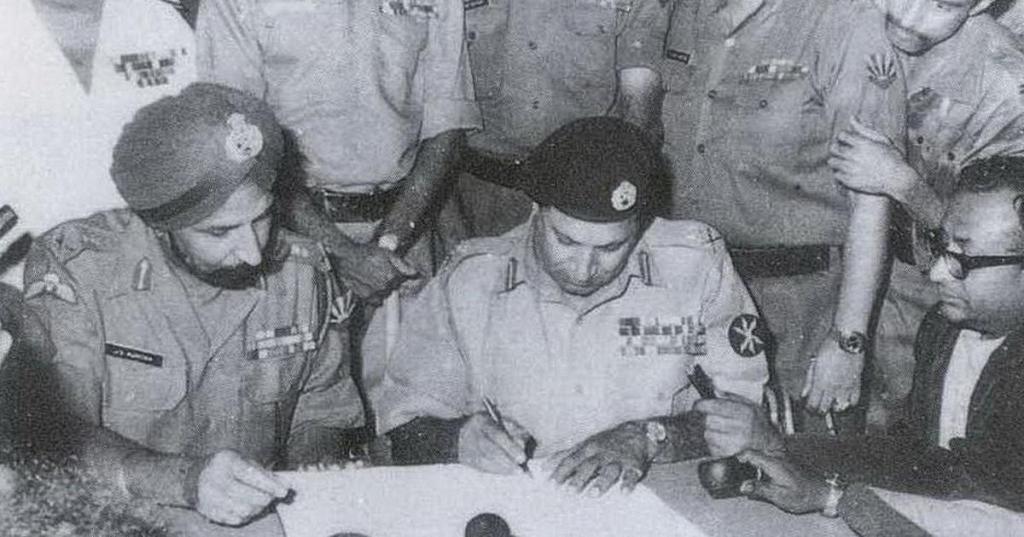
On December 16, 1971, General Niazi surrendered with 93,000 soldiers—the largest surrender since WWII. India didn’t stay to colonize; it withdrew, leaving behind a free nation. A lot of defence analysts now say, India should have at least sought a permanent fix for its chicken’s neck problem.
1975 vs. 2025: A Message to the Gen-Z of Dhaka
The current predicament of Sheikh Hasina—fleeing to India to escape a death sentence—is a tragic rhyme of history. In 1975, radicalized elements didn’t just assassinate her father, Sheikh Mujibur Rahman; they tried to incinerate the secular soul of the country. Today, we are witnessing what can only be described as a “Civilian-led 1975.”
The dismantling of the old order is absolute:
- The Ballot Ban: On December 24, 2025, the caretaker government led by Muhammad Yunus confirmed that the Awami League remains officially banned from the February 12, 2026, elections. The party that birthed the nation has been legally erased from its future.
- The Pakistan Pivot: For the first time since the blood-soaked surrender of 1971, Dhaka and Islamabad are actively drafting a Mutual Defense Pact. There is a crushing irony here: the grandchildren of those who were “purified” by the Pakistani Army are now negotiating military alliances with the heirs of their executioners.
- The Constitutional Reset: This February, Bangladesh won’t just vote for a new leader; it will vote on a referendum for the “July Charter.” Much like Pakistan’s “point of no return” in 1956, this referendum threatens to codify a new, radicalized identity, effectively voting away the linguistic and secular foundations laid in 1971.
The Gen-Z fought against the corruption and nepotism of the “Daughter” (Hasina). That was their democratic right. But in their righteous anger, they are inadvertently embracing the “Executioners” of the Father (Mujib).
When they align with Jamaat-e-Islami and welcome back the “Prince of Hawa Bhaban,” Tarique Rahman, they aren’t just changing a government. They are inviting back a force that once viewed their Bengali culture, their language, and their very existence as an “impurity” to be purged.
As Tarique Rahman addressed millions at the 300-Foot Road today—invoking Martin Luther King Jr. while standing on the soil he once fled—he spoke of a “Safe Bangladesh.”
But safe for whom?
Just days ago, in Mymensingh, a 27-year-old Hindu worker named Dipu Chandra Das was accused of “blasphemy,” forced to resign by his own colleagues, lynched, and set on fire while a crowd filmed the horror. The Rapid Action Battalion (RAB) has since confirmed there was no evidence of defamation—just a dispute with a factory owner that ended in a man being burned alive.
This is the “New Bangladesh” reality. While Gen-Z celebrates a “second independence,” they are trading a flawed democracy for a radicalized vacuum.
In 1971, India saved a nation from becoming a graveyard. In 2025, that same nation is discussing military pacts with the gravediggers. History doesn’t just rhyme in blood; in Dhaka today, it is screaming. If the youth do not look at the soil they stand on and remember whose blood soaked it in 1971, they will find that the “freedom” they won in 2024 was merely a door opened for the ghosts of their past to walk through.
Thanks for reading!!
Also read: What is happening in Bangladesh? All you need to know!



 Infinite Sea of Opportunities
Leave a comment