
Dhurandhar dropped strong hints about the fake currency nexus—how the system operates, who prints the currency, how it is transported, and who the stakeholders are. In an earlier post, I compared the cinematic portrayal with real-world mechanisms and highlighted where the film aligned with reality and where it diverged.
Have a look at : Fact vs. Fiction: What the film Dhurandhar Reveals About India’s Currency Security Crisis
The release of Dhurandhar 2 has done more than just provide weekend entertainment; it has ripped the bandage off a wound that many in the Indian political landscape thought had healed: Demonetization. Some recall the disruption, others see it as a bold systemic reset.
The film makes a staggering claim: a massive pipeline of ₹71,000 crore (split into two waves of ₹11,000cr and ₹60,000cr) was set to be pumped into the Indian economy by mid-November 2016. According to the film, demonetization prevented this.
While the opposition—led by the INC and Samajwadi Party—dismisses this as “cinematic propaganda,” a deep dive into the numbers suggests that while the movie’s figures are dramatic, the threat was terrifyingly real.
Is There a Way to Get Clarity?
Yes—through data.
Institutions like the Reserve Bank of India publish annual reports on fake currency detected in the banking system.
If we compare pre- and post-demonetization trends, we can begin to understand the real impact.
What matters is not just the number of fake notes, but their impact relative to the system:
- GDP size
- Total currency in circulation
- Detected fake currency
The following table provides the raw data:
| Year | GDP (₹ Lakh Cr) | Total Currency in Circulation (₹ Lakh Cr) | Fake Currency Detected (No. + ₹ Cr) | Impact (% of currency) |
|---|---|---|---|---|
| 2003–04 | 60 | 4.9 | 2.05 lakh (~10–12 Cr) | 0.002% |
| 2004–05 | 63 | 5.4 | 1.82 lakh (~9–10 Cr) | 0.0017% |
| 2005–06 | 68 | 6.1 | 1.24 lakh (~7–8 Cr) | 0.0013% |
| 2006–07 | 74 | 7.0 | 1.05 lakh (~6–7 Cr) | 0.0009% |
| 2007–08 | 83 | 8.3 | 1.96 lakh (~12–15 Cr) | 0.0015% |
| 2008–09 | 95 | 9.7 | 3.98 lakh (~20–25 Cr) | 0.0021% |
| 2009–10 | 106 | 11.1 | 4.01 lakh (~22–28 Cr) | 0.0020% |
| 2010–11 | 120 | 12.6 | 4.36 lakh (~25–30 Cr) | 0.0020% |
| 2011–12 | 135 | 14.3 | 5.21 lakh (~30–35 Cr) | 0.0024% |
| 2012–13 | 150 | 16.6 | 4.98 lakh (~28–32 Cr) | 0.0019% |
| 2013–14 | 160 | 18.3 | 4.88 lakh (~27–31 Cr) | 0.0017% |
| 2014–15 | 165 | 16.6 | 5.94 lakh (~40–43 Cr) | 0.0026% |
| 2015–16 | 150 | 16.6 | 6.32 lakh (~42–45 Cr) | 0.0027% |
| 2016–17* | 150 | 13.1 | 7.62 lakh (~43 Cr) | 0.0033% |
| 2017–18 | 160 | 18.0 | 5.22 lakh (~28–30 Cr) | 0.0016% |
| 2018–19 | 180 | 21.1 | 3.17 lakh (~17–20 Cr) | 0.0008% |
| 2019–20 | 200 | 24.2 | 2.96 lakh (~20–25 Cr) | 0.0008% |
| 2020–21 | 210 | 28.3 | 2.08 lakh (~8–10 Cr) | 0.0004% |
| 2021–22 | 230 | 31.0 | 2.30 lakh (~9–10 Cr) | 0.0003% |
| 2022–23 | 250 | 33.5 | 2.25 lakh (~8–9 Cr) | 0.0002% |
| 2023–24* | 270 | 35+ | ~2.22 lakh (~8 Cr est.) | 0.0002% |
Using the data in the table the following charts can be drawn:
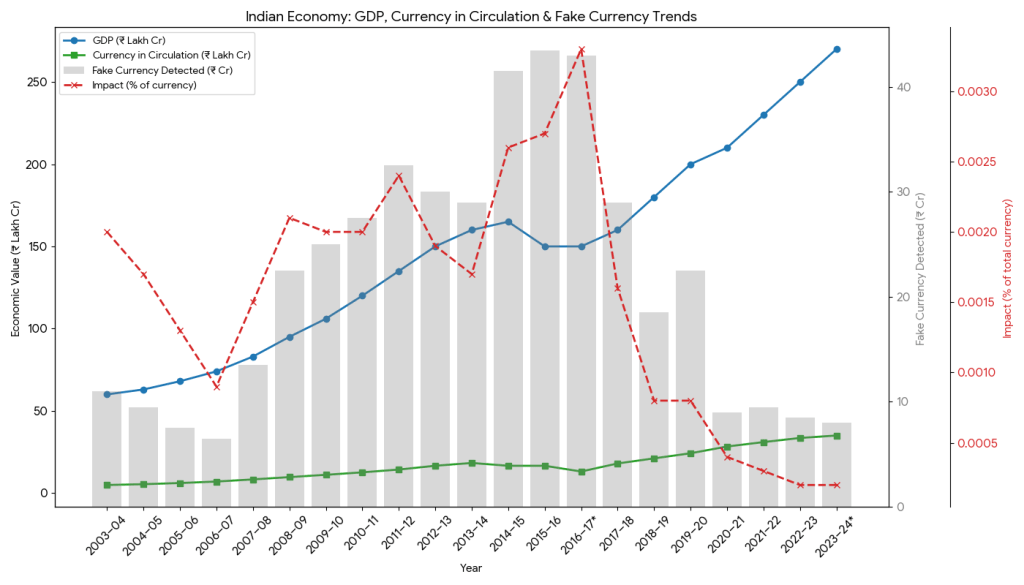
I📉 What the Data Shows
A few key patterns stand out:
1️⃣ Peak Just Before Demonetization
- 2015–16: ~6.32 lakh fake notes
- 2016–17: ~7.62 lakh (spike due to flushing out old notes)
This aligns with the idea that counterfeit currency had reached a local peak before demonetization.
2️⃣ Sharp Decline After Demonetization
- Fake notes dropped from ~7.6 lakh → ~2.2 lakh (by 2023–24)
- Value dropped from ~₹43 crore → ~₹8 crore
👉 That’s a significant reduction in absolute terms
3️⃣ Impact Collapsed Even More Dramatically
- 2016–17 impact: ~0.0033%
- 2023–24 impact: ~0.0002%
👉 That’s more than a 10x reduction in relative impact
💡 Why this matters:
The economy nearly doubled in size while fake currency shrank.
So even if counterfeit activity continued, its ability to influence the system weakened significantly.
The “Iceberg” Theory: Detected vs. Circulated
The most common critique of these figures is that ₹43 crore (the amount detected in 2016) is “too small” to justify a nationwide lock-down of cash. But this is a fundamental misunderstanding of how illicit economies work.
- The Detection Gap: Authorities estimate that banks only detect between 5% to 30% of fake notes in circulation. If we assume a conservative 5% detection rate, the ₹43 crore detected actually represents ₹860 crore of “active” poison in the economy.
- The Manufacturing Scale: Hostile actors (like the nexus depicted in Dhurandhar) don’t invest millions in high-tech printing presses and international smuggling routes to move a few lakhs. The logistical overhead requires massive volume to be “profitable.” Which makes thousands of crores understandable.
- The Invisible Deterrent: While the movie’s ₹71,000 crore figure may be a dramatization, the reality is that by invalidating the 500 and 1000 rupee notes, the government rendered the entire “warehouse” of printed fake currency worthless overnight. You don’t just measure success by what you catch; you measure it by what you pre-emptively destroy.
- There is no authority or institute other than the ISI that can confirm or deny if they had printed ₹71,000 crore worth of fake currency.
- Last, but not the least, Javed Khanani the architect of the nexus did die (alleged suicide by jumping from the roof of his building, but the movie says killed by Hamza) on Dec 4, 2016. That would be a very big coincidence that the ecosystem collapsed right after Demonetization.
The Political Fallout: The “Stash” Factor
The loudest protests against Demonetization didn’t come from the common man—who, despite the hardship, largely supported the move in subsequent elections—but from political entities.
The 2017 UP Elections serve as a historic case study. The “Cash Nexus” between crime and politics relies on massive liquidity. By sucking the oxygen out of the room, Demonetization effectively “reset” the playing field. The fact that the INC and SP have struggled to regain their footing in the decade following the move suggests that the “sting” was felt most acutely by those holding unaccounted stashes.
I wrote a complete article about the cash and political nexus, have a read here: The Cash Nexus: Criminals and Politics
Thanks for reading!
Do you know how someone like Atiq Ahmed fit into this system?
The film introduces a character inspired by a powerful UP politician—recently killed along with his brother—hinting at a deeper connection to the nexus.
In the next post, I break down how such figures may have intersected with these networks.
If you found this analysis insightful, consider subscribing to the blog—and don’t forget to hit like so I know this is the kind of deep dive you want more of.
Also read:










 Infinite Sea of Opportunities
Leave a comment