
The posters are everywhere. The memes are never ending. If you go on any digital platform you will see the craze that the movie has.
The headlines are screaming.
And the numbers? They’re historic.
Dhurandhar 2: The Revenge has not just broken records—it has vaporized them. Crossing ₹1,000 crore in record time, it is being celebrated as a defining moment for Indian cinema.
But here’s a question no one is asking:
What exactly are we celebrating?
Are we witnessing the rise of a truly mass cinematic culture?
Or are we applauding a statistical illusion—one built on high ticket prices, urban concentration, and limited access?
Because beneath the ₹1,000 crore milestone lies a far more uncomfortable truth:
97% of Indians still don’t have access to cinema screens!
1. The Ticket Math No One Talks About
Box office numbers in India are always presented in rupees. Big numbers. Round numbers. Emotional numbers.
But numbers don’t tell stories—people do.
Let’s break it down.
- India Gross (Day 11): ~₹1,011 crore
- Average Ticket Price (ATP): ~₹250
That gives us:
~4 crore tickets sold
At first glance, that’s massive.
4 crore people is larger than the population of many countries.
But now zoom out.
India has a population of 145 crore.
Which means:
Only ~2.7% of Indians have watched the biggest blockbuster in the country.
And if you consider repeat watchers like myself who watched the movie two times, the percentage would go even lower. But for the sake of this post lets assume the 4 crore tickets sold were to unique visitors and nobody watched the movie twice.
Let that sink in.
2. A Nation Watching… or a City Celebrating?
In countries like the US or the UK, a blockbuster is a shared cultural moment.
- In the US, films like Endgame reached nearly 30% of the population.
- In the UK, major releases often cross 20%.
That means:
- Offices discuss it
- Families plan around it
- It becomes part of everyday conversation
Now compare that to India.
A “historic” blockbuster here:
Reaches less than 3% of the population
That’s not a national phenomenon.
That’s an urban event—mistaken for a national one.
3. The Easy Explanation: “Indians Can’t Afford It”
The immediate reaction is predictable:
“India is a developing country. People simply can’t afford movies.”
There is some truth to this—but it’s not the full story.
Let’s look deeper.
- Average ticket price in India: ~₹250 (~$3.20)
- UK: ~₹1,100 (~$13.30)
At face value, India looks cheap.
But now adjust for purchasing power.
A ₹500 multiplex ticket in India (with snacks) is not “cheap.”
For many, it’s equivalent to a $50–$60 outing in Western terms.
For a daily wage earner, that’s not entertainment—it’s a financial decision.
But here’s the twist:
Even for those who can afford it, there’s a bigger issue.
They often don’t have access.
4. India’s Real Crisis: The “Theatrical Desert”
India doesn’t have a demand problem.
It has an access problem.
Consider this:
| Country | Total Screens | Screens per Million |
|---|---|---|
| USA | ~40,500 | ~120 |
| China | ~82,000 | ~58 |
| UK | ~4,400 | ~64 |
| India | ~9,927 | ~6.8 |
India produces ~2,000 films a year—more than any other country.
And yet, it has one of the lowest screen densities in the world.
This is not just a gap.
This is a structural failure.
5. The Pin Code Crisis: A Forgotten India
The problem becomes even starker when you zoom into geography.
- Total pin codes in India: ~19,000
- Pin codes with cinema screens: ~3,150
Which means:
Over 16,000 pin codes have zero cinema access.
Think about what that means in real life.
For millions of Indians:
- Watching a film is not a spontaneous decision
- It requires travel, planning, and expense
- It becomes a day-long commitment, not a leisure activity
This is what we can call:
“Media-Dark India”
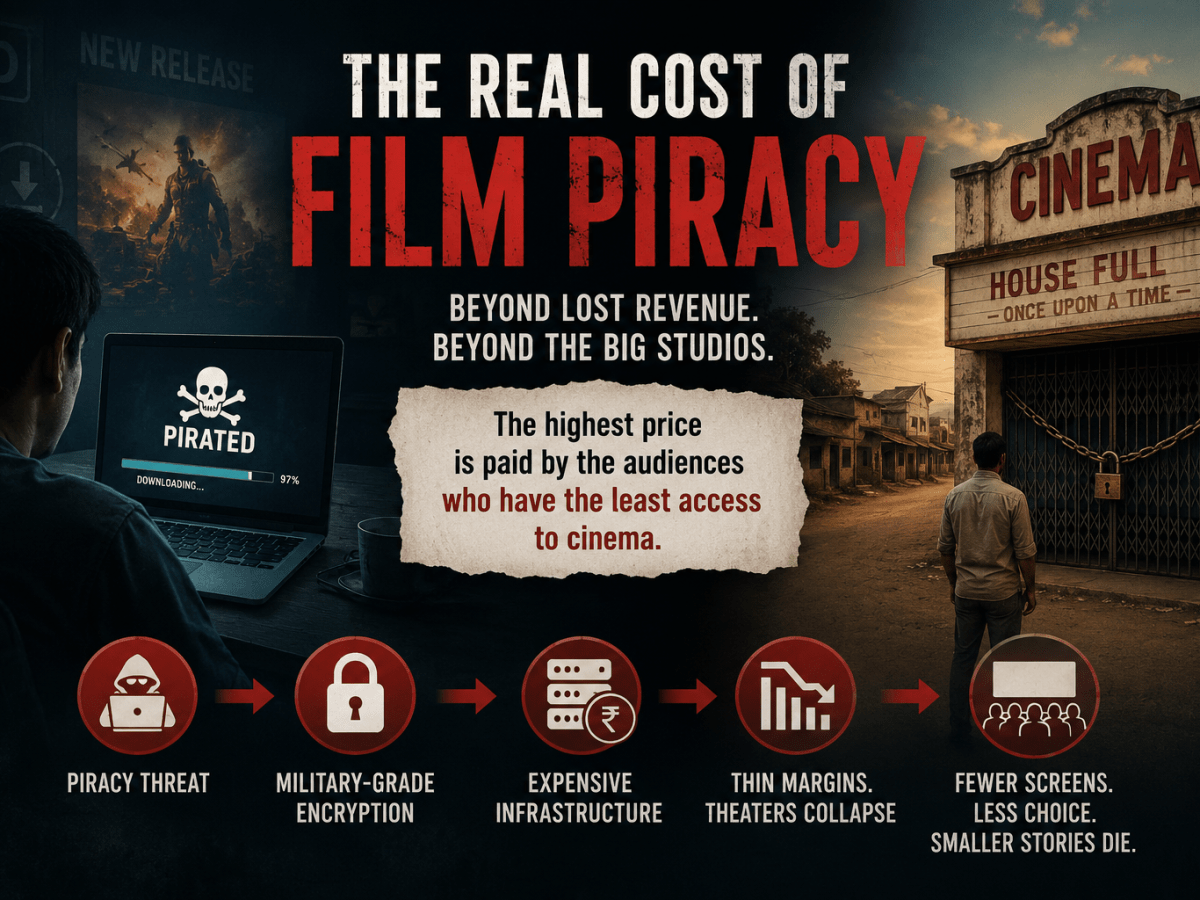
And this is where OTT and piracy step in—not as disruptors, but as replacements for missing infrastructure.
6. Why Aren’t More Theatres Being Built?
If demand exists, why isn’t supply catching up?
The reasons are well known—and deeply structural.
a) The Tax Burden
Cinema is taxed at 18% GST, often with additional local levies.
Instead of being treated as cultural infrastructure, it is treated like a luxury commodity.
b) The Real Estate Trap
Multiplexes are tied to malls.
- High rent
- High maintenance
- Urban concentration
Standalone theatres?
They require navigating a maze of approvals—often 50–70 licenses.
c) The Popcorn Economy
Theatres don’t make most of their money from tickets.
Distributors take ~50% of ticket revenue.
So theatres survive on:
- Food
- Beverages
- Add-ons
Which is why:
Cinema in India feels expensive—even when tickets aren’t.
But these reasons, as significant as they are, still don’t explain one thing:
Why has India’s screen count stagnated despite rising demand?
The answer lies in a less visible, more powerful force:
Control.
When access to content is controlled, expansion stops being a market outcome—and starts becoming a permissioned system.
7. The Invisible Barrier: The Tech–Distribution Chokepoint
Modern cinema distribution is no longer physical—it is digital.
Films are delivered through encrypted systems.
Theatres don’t just “play” movies—they need authorized digital keys.
Which raises critical questions:
- Who controls these keys?
- Who decides which theatre gets access on Day 1?
- Why do smaller towns struggle to get timely releases?
This is where the industry moves from economics into gatekeeping.
Because if access to content is controlled,
then expansion of screens can also be… controlled.
This is not just a business issue.
It’s a structural chokepoint.
And it deserves a deeper investigation.
This is Part 1 of a deeper series on the structural chokepoints in Indian cinema. If this made you rethink the numbers, stay tuned—the next piece goes deeper into the technology and control behind distribution.
Also, please hit like to let me know that we are on the same page so far.
8. The Ceiling of Indian Cinema
Now let’s return to where we started.
₹1,000 crore.
A number that dominates headlines.
A number that signals success.
But what if it also signals a limit?
Because here’s the reality:
If India had:
- the screen density of China
- the accessibility of the US
- the geographic spread of the UK
Then a brilliant film like Dhurandhar 2 wouldn’t make just ₹1,000 crore.
It would make ₹10,000 crore.
Simply because more Indians would be able to watch it.
9. The Real Story
This is not a story about one film.
It is a story about:
- access vs demand
- infrastructure vs narrative
- reality vs perception
India is not a nation that doesn’t watch films.
It is a nation that has been systematically limited in how it can watch them.
10. Final Thought
So the next time we celebrate a ₹1,000 crore blockbuster, we should pause and ask:
Are we celebrating scale—or celebrating scarcity?
Because this isn’t just a success story.
It’s a 16,000 pin code failure.
Until that changes, Indian cinema will remain what it is today:
A giant with its hands tied—
performing for a small, crowded, urban room.
Thanks for reading!
Also read:











Leave a comment