
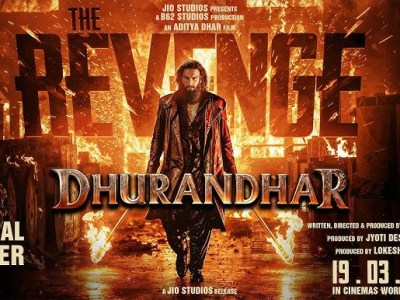
When a film franchise manages to hold attention for nearly eight hours across two parts, it is already doing something very unusual in Indian cinema. Dhurandhar 1 and Dhurandhar 2 feel like exactly that kind of rare experiment—ambitious, dense, and surprisingly consistent in quality, yet emotionally and structurally very different from each other.
What makes this duology stand out is not just the scale or the subject matter, but how differently each part feels while still belonging to the same narrative universe. On paper, both films follow a similar template: espionage, underworld politics, cross-border intelligence operations, and a deep dive into Lyari’s socio-political fabric. But in execution, they diverge in tone, rhythm, and emotional impact.
That contrast is exactly why audiences are split—some prefer the grounded storytelling of Part 1, while others are drawn to the fast, information-heavy intensity of Part 2. Personally, both worked, but in completely different ways.
A Rare “Black Swan” Moment in Indian Cinema
Let’s start with the bigger picture.
Both Dhurandhar 1 and Dhurandhar 2 feel like a “black swan” event in mainstream Indian filmmaking. Everything—from storytelling to screenplay structure, background score, and pacing—comes together in a way that is extremely rare.
There is a confidence in direction that is hard to ignore. Even though each film runs close to four hours, neither feels unnecessarily long. That alone is a massive achievement. Most long-form Indian films struggle to maintain engagement beyond the two-and-a-half-hour mark without fillers like songs and item songs, but here the pacing is controlled in a way that keeps you invested.
Music, tension-building, and narrative layering all work in sync. There are moments where you genuinely forget the runtime, which is probably the highest compliment you can give to this kind of storytelling.
But despite these shared strengths, the two parts feel like two different emotional journeys.
The Shared Narrative DNA
Before comparing them, it’s important to understand what connects both films.
At their core, both parts explore:
- The political and criminal ecosystem of Pakistan’s underworld, especially Lyari and Karachi
- The influence and manipulation by intelligence structures like ISI
- The socio-political tension in Balochistan, often shown through a sympathetic lens
- The blurred line between militants, gangsters, and political actors
- A recurring theme of “welcome into the system” that later turns into control and betrayal
Both films also hint at real-world inspired events—though dramatized heavily for cinematic effect. There is a constant layering of fiction over real geopolitical tensions, which gives the films their grounded intensity.
However, how these ideas are presented is where the real difference begins.
Dhurandhar 1: Character-Driven, Emotional, and Grounded
Dhurandhar 1 feels like a deep dive into one ecosystem.
The film spends time building Lyari—not just as a location, but as a living, breathing world. You get introduced to gang structures, internal rivalries, emotional relationships, and the fragile power balance that holds everything together.
The storytelling here is slower, but intentionally so.
The emotional core of the film revolves around figures like Rehman Dakait and the ecosystem around him. His rise and fall become the central spine of the narrative. The audience is allowed to sit with characters, understand their motivations, and even feel a strange emotional attachment to people who operate in morally grey spaces.
That’s where the film succeeds brilliantly.
Even supporting characters like Jameel Jamale bring in moments of relief and humor, balancing the heavy tone. The writing doesn’t rush to move from one event to another. Instead, it allows tension to build naturally.
By the time the film reaches its climax—centering on Rehman Dakait’s death—the emotional weight lands properly because we have actually spent time inside that world.
This is what makes Part 1 feel cinematic in a traditional sense. It is character-first storytelling, layered with realism and dramatization.
Even though the events are inspired by real incidents like police encounters and gang conflicts, the film takes creative liberty to heighten drama, which works in its favor.
The result is simple: Part 1 feels immersive.
Also read: Dhurandhar—The 3.5-Hour Epic That is Filling Theaters in the UK: A Non-Spoiler Review
Dhurandhar 2: Fast, Dense, and Information Heavy
Then comes Dhurandhar 2! The audience must have expected an extension of where the first part ended. At least I did. I even wrote an article on the people who would die next.
Have a look: Dhurandhar Part 2: What Happens Next in Lyari? The Brutal Real-Life Deaths
Although the same people did die exactly as they died in reality, the storytelling style was entirely different.
If Part 1 is about immersion, Part 2 is about acceleration.
Instead of focusing on one ecosystem, the sequel expands horizontally across multiple timelines, operations, and geopolitical events. The narrative becomes much more fragmented but also significantly broader in scope.
We move quickly between:
- Gang conflicts and assassinations
- Intelligence operations
- Financial networks and hawala systems
- Political transitions and external triggers like demonetization
- Covert operations involving unknown actors
- Large-scale strikes on militant infrastructures
The emotional storytelling takes a back seat, and information becomes the dominant force.
At times, it genuinely feels like a cinematic documentary—but in a good way. Not boring, not dry, but extremely dense. You are constantly processing events rather than sitting with characters.
Even new arcs like Jaskirat’s transformation into the “Dhurandhar” feel more conceptual than emotional. The film is less about “who these people are” and more about “what is happening across the system.”
This shift is bold, and it doesn’t always feel comfortable, but it is surprisingly effective.
Despite the fast pacing and information overload, the film still manages to keep you hooked. That is not easy. It suggests strong control over narrative rhythm, even when the content is complex.
The Big Difference: Emotion vs Information
The real dividing line between the two films is simple:
- Part 1 = Emotion + World-building
- Part 2 = Information + System-building
Part 1 makes you feel like you are inside Lyari, watching lives unfold.
Part 2 makes you feel like you are looking at a map of interconnected geopolitical actions.
Neither approach is better—they are just fundamentally different storytelling philosophies.
Historical Liberties and Timeline Shifts
One of the most interesting contrasts between Dhurandhar 1 and Dhurandhar 2 lies in how they handle time.
Dhurandhar 1 follows a largely linear and faithful timeline, which adds to its grounded, immersive feel. The sequence of events unfolds in a way that closely mirrors reality: Hamza’s arrival in Lyari around 2004, the reinstatement of the SP during the same period, the formation of the Pakistan Aman Committee in 2007, the ripple effects of the 2008 Mumbai attacks, and finally, the encounter killing of Rehman Dakait in 2009. This chronological discipline allows the audience to organically absorb the rise and fall of characters within a clearly defined historical framework. It feels almost like you are watching history unfold in real time, with cinematic enhancements.
Dhurandhar 2, however, takes a very different—and far more aggressive—approach to time.
Instead of following events as they occurred year by year, the film compresses and rearranges timelines to serve narrative momentum. Importantly, the events themselves are not fictionalized—they are shown largely as they happened—but their placement in time is altered to create a tighter, more intense storytelling experience.
For instance, the assassination of SP Chaudhary Aslam, which occurred in a suicide attack in 2014, is depicted in the film as happening much later, seemingly in a post-2016 context. Similarly, the “Unknown Gunmen” chapter—where multiple anti-India operatives are eliminated—actually spans a period from roughly 2020 to 2024 in reality. In the film, however, this entire sequence is condensed into what feels like a matter of days, or at most weeks, giving it a sense of rapid, coordinated execution.
Another example is the strike on Markaz-e-Taiba in Muridke, which in reality took place in 2025. The film shifts its placement to align with its climactic arc, making it feel like the culmination of a continuous chain of events rather than a standalone operation separated by time.
This approach leads to a few noticeable patterns in Dhurandhar 2:
- Key police encounters and assassinations are repositioned along the timeline to maintain narrative intensity
- Financial and political disruptions are linked more tightly than they were in reality, creating a cause-and-effect illusion
- The “Unknown Gunmen” storyline is presented as a sustained, unified campaign rather than a series of disconnected incidents
At first glance, this might seem like a compromise on historical accuracy. But in reality, it is a deliberate storytelling choice.
By compressing time, the film transforms a scattered set of real-world events into a cohesive narrative thread. The audience is not asked to track years—they are asked to track momentum. This makes the film feel faster, denser, and more urgent.
Interestingly, this is also what gives Dhurandhar 2 its documentary-like quality. Not because it is strictly accurate in chronology, but because it presents a structured interpretation of reality. It connects dots, builds patterns, and constructs a version of events that highlights systemic relationships rather than isolated moments.
In that sense, the film is not trying to function as a historical record. It is trying to act as a narrative model of how such a system operates.
And that distinction—between documenting history and interpreting it—is exactly what defines the tonal shift between Part 1 and Part 2.
Could There Have Been a Third Film?
Honestly, yes.
Part 2 is so dense that it feels like it could easily be split into two separate films. The amount of information, timelines, and operations covered is massive. A slower version of Part 2, structured like Part 1, could have expanded certain arcs more deeply.
Take Arjun Rampal’s character, Major Iqbal, for instance. In reality, his arc concludes much earlier, but the film keeps him alive until the very end. This clearly feels like a narrative shortcut—an intentional decision to avoid introducing and developing another ISI handler in an already crowded screenplay. While this works from a pacing standpoint, it dilutes realism and slightly reduces the impact of the broader intelligence ecosystem the film is trying to portray.
Then there’s the entire nexus involving fake currency and its routing through slaughterhouses—a deeply complex and disturbing network that is only briefly touched upon. This could have been an entire subplot on its own, exploring financial warfare, grassroots distribution channels, and their socio-political implications. Instead, it flashes by as just another data point in an already overloaded narrative.
Must read: Fact vs Fiction: Dhurandhar 2, ₹60,000 Cr FICN, and the Real Impact of Demonetization and Fact vs. Fiction: What the film Dhurandhar Reveals About India’s Currency Security Crisis
Similarly, the role of Atiq Ahmed feels underexplored. The film leans into a somewhat lighter, even comedic portrayal at times, which stands in stark contrast to the gravity of his real-world notoriety. His network, influence, and the scale of his operations are hinted at, but never fully unpacked. The absence of his darker, more brutal dimensions creates a tonal imbalance and leaves a noticeable gap in the storytelling.
The downfall of Samajwadi Party and the end of Akhilesh Yadav’s political career!
And this is the recurring theme across Part 2—there simply isn’t enough time.
Not enough time to sit with characters.
Not enough time to build tension within subplots.
Not enough time to let the audience absorb the full weight of what is being shown.
But here’s the paradox: this very compression is also what gives Dhurandhar 2 its edge.
The film’s urgency—its breathless, almost documentary-like momentum—comes directly from this decision to condense. Splitting it into two parts might have added depth, but it could also have reduced the intensity that keeps the audience hooked from start to finish.
Final Verdict
Both Dhurandhar 1 and Dhurandhar 2 are excellent, but they succeed in very different ways.
- Dhurandhar 1 is the more cinematic, emotional, and character-driven experience.
- Dhurandhar 2 is the more ambitious, complex, and system-oriented experience.
Together, they form something larger than a typical sequel structure. It feels like a two-part exploration of the same world from two completely different lenses.
And maybe that’s why the experience stays with you.
In fact, very few films ever manage this: I personally can’t think of another Indian film that I’ve gone back to watch more than once in theatres. That alone says a lot about the grip these films have.
In the end, whether you prefer Part 1 or Part 2 comes down to what you value more—emotional storytelling or narrative scale. But the real achievement is that both exist at such a high level that the comparison itself becomes interesting.
And that’s exactly what makes Dhurandhar feel like a rare cinematic moment.
Thank you for reading!
Also read:







 Infinite Sea of Opportunities
Leave a comment