
The Russia–Ukraine war has starkly exposed the strategic vulnerabilities that emerge when modern nations rely on private, foreign-controlled satellite constellations for critical national security and military communications.
While commercial Low-Earth Orbit (LEO) networks like Starlink proved indispensable in keeping Ukrainian defense forces and civilian infrastructure connected following the systematic destruction of legacy terrestrial communications, the conflict has also demonstrated how operational restrictions—whether driven by corporate terms of service, regulatory compliance, or geopolitical signaling—can directly alter battlefield outcomes.
At the center of this debate is a profound systemic risk: What are the long-term technical and strategic implications of allowing a private corporation and a foreign government to exercise a de facto veto over a sovereign nation’s communications infrastructure?
To understand the mechanics of this vulnerability, one must examine three key developments from the conflict through a rigorous technical lens, looking beyond political arguments and analyzing the underlying network and radio-frequency realities.
1. Address-Based Deactivation (Whitelisting & Blacklisting)
The Incident
During the conflict, frontline reporting highlighted that opposing forces had managed to acquire commercial Starlink terminals through third-party intermediaries, deploying them on the front lines for secure tactical internet. To counter this, Ukrainian authorities collaborated with SpaceX to implement strict access control protocols.
The Technology
Deactivating or restricting specific ground dishes is conceptually straightforward at the network architecture layer. Every Starlink terminal relies on unique hardware identifiers, including MAC addresses, physical cryptographic keys, and registered serial numbers.
When a terminal communicates with the constellation, it must authenticate its identity against a centralized database managed by the network operations center (NOC). If unauthorized terminals are identified—or if a government requests the purging of black-market units operating in forbidden sectors—the operator simply transmits a remote software command. This instruction blacklists the specific hardware identifiers, effectively “bricking” the terminal and rendering it a useless piece of hardware until reauthorized.
2. Velocity Capping & Dynamic Geofencing
The Incident
Ukrainian military units began jury-rigging standard flat-panel Starlink user terminals onto fast-moving aerial and naval attack drones to maintain real-time video feeds and long-range guidance links. In response, SpaceX implemented firmware updates and speed restrictions, causing terminals to lose connectivity when traveling above roughly 160 km/h (100 mph).
The Technology
This restriction combines software-defined velocity thresholds with physical-layer Doppler shift monitoring. Because LEO satellites travel at extreme speeds (roughly 27,000 km/h) relative to the Earth, the system must continuously calculate and compensate for Doppler shifts to maintain a stable radio link.
The terminal and satellite modems inherently measure frequency shifts to lock onto signals. By analyzing these Doppler metrics, the system can precisely determine the relative velocity of the ground terminal. If the onboard firmware detects that a terminal is moving faster than a predetermined threshold—such as being mounted to a fast-moving drone or missile—the network server automatically drops the session. This prevents commercial broadband hardware from being weaponized into autonomous guidance systems without requiring physical access to the device.
3. Satellite-Side Beam Steering & Physical Downlink Control
The Incident
Perhaps the most politically explosive event occurred when a request to activate Starlink coverage off the coast of Crimea to support a maritime drone strike against the Russian Black Sea Fleet was denied. This effectively blocked downlink connectivity across specific geographic coordinates during a critical operational window.
The Technology
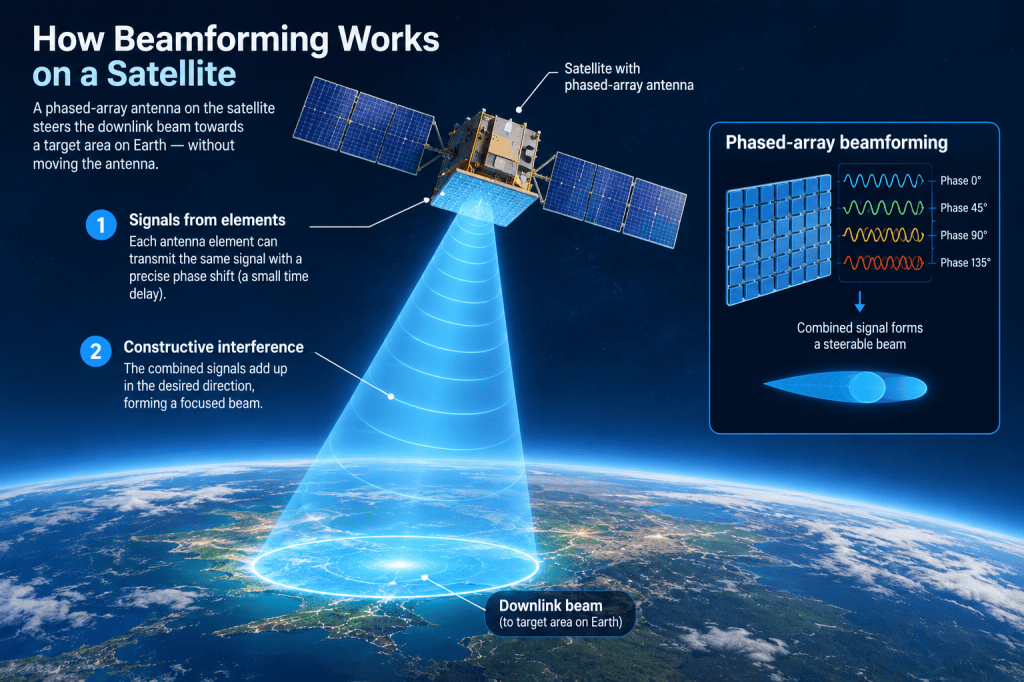
While ground-side geofencing can block IP traffic, spatial access can also be controlled directly at the satellite array level via electronically steered phased-array beamforming. This represents the most powerful and difficult-to-circumvent layer of control.
- Phased-Array Architecture: Unlike traditional geostationary satellites that point large mechanical dishes toward fixed regions, Starlink satellites utilize flat-panel phased arrays. Neither the satellite nor the user terminal physically moves; instead, they dynamically adjust the relative phase and gain of individual antenna elements to electronically steer focused radio frequency beams.
- Real-Time Beam Scheduling: Managing phase-weight distributions across thousands of antenna elements is a core, continuous part of satellite operation. It is required just to maintain routine broadband coverage as satellites streak across the sky.
- The Sovereign Implication: To exclude a specific region from coverage, the constellation controller does not need to invent a new technology. It simply instructs the satellite scheduler to suppress phase construction and beam-forming for a specific set of coordinates. The satellite refrains from forming active downlinks over the target area.
Legal battles, regulatory disputes, and diplomatic protests can continue indefinitely after the fact, but at the critical moment of execution, physical-layer downlink connectivity remains entirely unavailable.
The Strategic Dilemma for Sovereign Nations
The friction witnessed in Ukraine highlights an uncomfortable truth for modern military and telecommunications planners: standard commercial terms of service are fundamentally incompatible with sovereign defense requirements.
When a nation permits a foreign-owned, privately managed LEO constellation to anchor its critical infrastructure, it creates several structural vulnerabilities:
- The Physical Layer Primacy: No domestic telecommunications law, data protection mandate, or local regulation can override a foreign operator’s software control over satellite phase weights, beam scheduling, or Doppler velocity thresholds. The physics of the radio link obey the entity holding the cryptographic keys and network command software.
- The Metadata and Traffic Analysis Threat: Even when user data payload is encrypted end-to-end, the constellation operator retains complete visibility over high-value metadata, including precise terminal GPS coordinates, burst timings, data throughput volumes, and RF radio-frequency fingerprints. This exposes troop concentrations and operational tempos to external oversight.
- The Jurisdictional Risk: Companies domiciled in foreign states remain subject to their home country’s domestic legal frameworks (such as extraterritorial national security directives), meaning local compliance laws can be abruptly overridden by foreign executive power.
How Nations Must Adapt
Following the lessons learned from Ukraine, emerging spacefaring and regional powers—including India—are fundamentally rethinking how they approach foreign LEO broadband providers. To harness the undeniable commercial and remote-connectivity benefits of LEO mega-constellations without compromising national security, governments are establishing a new playbook:
- Mandatory In-Country Gateways: Forcing all domestic data traffic to land at physical, nationally regulated ground stations within sovereign borders, preventing traffic from bypassing local routing nodes via space-based optical inter-satellite links.
- Multi-Constellation Ecosystems: Avoiding single-provider dependencies by fostering a diverse mix of domestic providers, allied commercial networks, and localized alternatives.
- Absolute C4ISR Air-Gapping: Reserving core military command, control, intelligence, and strategic defense communications exclusively for sovereign, state-controlled satellite constellations (such as dedicated military payloads) where the hardware, software, and operational control rest entirely in national hands.
The commercial space race has democratized global connectivity, but it has also blurred the line between civilian infrastructure and strategic leverage. Without guaranteed architectural sovereignty over the physical layer, any nation relying entirely on foreign commercial constellations inevitably delegates a portion of its national destiny to external hands.
Thanks for reading! Do let me know what do you think about it in comments.
Also read:













Leave a Reply